
The typical air purifier cost to run is about $1 to $12 a month in electricity, or roughly $12 to $147 a year, running nonstop at the recent US average rate of about 17¢ per kWh. Most home units land near $2 to $6 a month. Filters can cost as much as the power, so this guide covers both.
What is the air purifier cost to run per month and year?
At about 17¢ per kWh, close to the recent US residential average reported by the EIA, a purifier running 24 hours a day costs roughly $1 a month on a low setting and about $6 a month at 50 W. Only large, powerful units on high pass $10. Your rate and your model will move these numbers, so treat the table as a range, not a quote.
| Fan setting | Example draw | kWh per month (24/7) | Cost per month | Cost per year |
|---|---|---|---|---|
| Low | 8 W | 5.8 | $0.98 | $11.75 |
| Medium | 20 W | 14.4 | $2.45 | $29.38 |
| High | 50 W | 36 | $6.12 | $73.44 |
| High, large unit | 100 W | 72 | $12.24 | $146.88 |
These wattages are illustrative, not test results. Spec sheets for small and mid-size home purifiers commonly list single digits to low tens of watts on low and several dozen watts on high, but it varies by model. Running 12 hours a day instead of 24 cuts every figure in half.
How do you calculate what your own air purifier costs?
Use this formula: watts ÷ 1,000 × hours per day × 30 days × your rate per kWh = monthly cost.
- Find the watts. Check the label on the back or bottom, or the spec sheet. Some list watts per speed. If you only see amps, multiply by 120 volts for the maximum draw. Actual use on low is usually far lower.
- Find your rate. Look at your utility bill for the total cost per kWh, including delivery charges, not just the supply line.
- Estimate hours at each speed. Most people split time between low or auto and a few hours on high.
- Multiply and add up.
Worked example 1: a 60 W unit, 12 hours a day
0.06 kW × 12 hours × 30 days = 21.6 kWh. At 17¢ that is about $3.67 a month, or about $44 a year.
Worked example 2: mixed speeds
Say 4 hours on high (50 W) and 20 hours on low (8 W) each day. That is 0.2 kWh plus 0.16 kWh, or 0.36 kWh a day. Over 30 days that is 10.8 kWh, or about $1.84 a month and $22 a year at 17¢.
Measure it instead of guessing
A plug-in watt meter (the Kill A Watt type) shows real draw. Plug the purifier into the meter, run each speed for a few minutes, and write down the watts. Leave it plugged in for a few days to get kWh with your actual habits. The label rating is a maximum, so measured numbers are often lower.
How much do local electricity rates change the cost?
A lot. The same purifier costs more than three times as much to run in a high-rate area as in a low-rate one. The table uses a 20 W medium-speed unit running 24/7 (14.4 kWh a month, 172.8 kWh a year). Rates are examples, not state quotes.
| Rate per kWh | Who tends to pay it | Per month | Per year |
|---|---|---|---|
| 10¢ | Low-rate utilities, such as some in the Northwest | $1.44 | $17.28 |
| 17¢ | Near the recent US average | $2.45 | $29.38 |
| 25¢ | Many high-cost regions | $3.60 | $43.20 |
| 35¢ | Highest-cost areas, including parts of California and Hawaii | $5.04 | $60.48 |
The EIA publishes average residential prices by state, but your own bill is the better number. If your plan has time-of-use pricing, the evening peak rate can be well above your average, so check when your purifier runs on high.
Do fan speed, auto mode and standby change the cost?
Yes, fan speed is the biggest lever. Fan power climbs faster than airflow as speed rises, so a unit on its top setting can draw many times what it uses on low while moving only a few times more air. Running a bit lower for longer is usually cheaper than short bursts on high for the same cleaning.
- Auto mode uses a particle sensor to raise the fan only when air quality drops. It can save power in a clean home, but the sensor, display and any Wi-Fi radio add a small constant draw.
- Sleep mode lowers the fan and dims lights, so it is usually near the lowest wattage the unit offers.
- Standby varies by model. Units with displays or Wi-Fi may draw a watt or two while idle. At 2 W all year (17.5 kWh), that is about $3 at 17¢, so unplugging is not worth the hassle.
Are ENERGY STAR purifiers cheaper to run?
Generally yes, but the savings are modest. The EPA says ENERGY STAR certified room air cleaners are more efficient than standard models, and has cited roughly 25%; confirm the current figure and product list at energystar.gov. The program rates efficiency as clean air delivered per watt and limits standby power. Even a 25% cut on a $29 yearly power bill saves about $7. Do not overpay for the label if a non-certified model fits your room better.
If you want a real unit to plug into the formula, our Winix air purifier review lists its fan speeds and specs.
How much do filters add to the yearly cost?
Filters are the part many cost guides skip, and they can equal or exceed the electricity. Use this formula: filter price × replacements per year = yearly filter cost. Manufacturers commonly call for HEPA replacement every 6 to 12 months and carbon filters sooner or on the same schedule. The real interval depends on the model, runtime, smoke, pets and local air quality, so follow your manual.
Worked example with placeholder prices
These prices are for the math only, not a quote. Say a replacement filter costs $40 and the manual says every 6 months. That is $80 a year. Add $29 of electricity for a 20 W unit on 24/7 at 17¢, and the total is about $109 a year. Swap in your model’s actual filter price and your own wattage.
Look at cost per CADR, not just cost per year
The cheapest unit to run is not always the cheapest way to clean your air. An undersized purifier forced onto high can use more power per unit of clean air than a bigger one on low. The AHAM rule of thumb is a smoke CADR of at least two-thirds of the room’s square footage for 8-foot ceilings.
- A 300 sq ft room needs a smoke CADR of about 200 or more.
- Divide your total yearly cost (power plus filters) by the CADR at the speed you will actually use.
- Pick the lower number among units that meet the room’s CADR target.
Our guide to how to choose an air purifier walks through room size and CADR. For a smaller room, the LEVOIT Core 300-P review shows one example’s listed specs and filter details.
Third-party filters can be cheaper, but check that they are true HEPA and fit your model. Some manufacturers say non-brand filters can void the warranty.
How does that compare with a fridge, AC or dehumidifier?
A purifier is one of the cheaper appliances to leave on. The figures below are typical ranges and vary by model, size and climate; the EnergyGuide label on your own appliance is more reliable.
| Appliance | Typical draw while running | Rough kWh per year |
|---|---|---|
| Air purifier, 20 W, 24/7 | 20 W | about 173 |
| Air purifier, 100 W high, 24/7 | 100 W | about 876 |
| Box fan, high | about 50 to 100 W | depends on hours |
| Refrigerator | cycles on and off | often 300 to 600 |
| Dehumidifier | several hundred watts | depends on humidity and hours |
| Window AC | roughly 500 to 1,400 W | depends on hours and climate |
A mid-range purifier on medium uses less than many refrigerators in a year. A big unit left on its top speed 24/7 can use more. The EIA lists the average US home at roughly 850 to 900 kWh a month, so even 36 kWh from a 50 W unit is a few percent of a typical bill.
Is it OK to run an air purifier 24/7, and how do you cut the cost?
Yes. Household purifiers are designed for continuous use, and most manuals recommend it for allergy and smoke control. Continuous low-speed running is often better for air quality than turning the unit on and off. Check your manual for any runtime limits.
Safety checklist
- Plug directly into a wall outlet. Avoid daisy-chained power strips and thin extension cords.
- Unplug before changing filters or cleaning.
- Keep it away from water, curtains and other flammable materials, and leave the clearance the manual specifies.
- Buy only units with UL or ETL safety certification.
- Skip ozone-generating air cleaners. The EPA and California’s CARB warn about ozone, and California limits certified models to 0.050 ppm.
- Stop using the unit and have it checked if the cord or plug feels hot or you smell burning.
Ways to lower the bill
- Right-size by CADR. A properly sized unit can run on low or medium instead of straining on high.
- Use auto or sleep mode for everyday running, and go higher only while cooking, cleaning or during smoke events.
- Keep doors closed in the room you are cleaning so you are not treating the whole house.
- Replace filters on schedule. A clogged filter cuts airflow and cleaning performance.
- Give it space. Keep the intake and outlet clear of walls and furniture.
When you are ready to shop, start with our best air purifiers roundup. If you have a specific problem, the best air purifiers for allergies list narrows it down. For a mid-size unit with listed specs, see our Coway Airmega Mighty2 review.
Our Top Picks
Ready to shop? These are the top-rated options from our hands-on roundup, Best Air Purifier For Home of 2026.

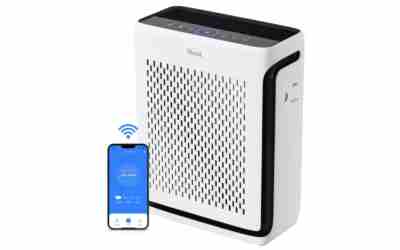
LEVOIT Vital 100S-P Air Purifier for Home, Pets, and Bedroom, Up to 1073 Sq Ft, HEPA Sleep Mode, Washable Pre-Filter, Smart Air Quality Monitor, White

KNKA APH4000 Air Purifier for Home Bedroom, HEPA Sleep Mode Air Cleaner with Washable Pre-Filter, AHAM Verified, AQI Display, Pet Mode for Pet Dander, Dust & Pollen, Up to 1,695 Sq Ft, White

FreAire HAP605 Air Purifier for Large Rooms
As an Amazon Associate we earn from qualifying purchases. Product prices and availability are accurate as of the date/time indicated.
Frequently Asked Questions
Does an air purifier use more electricity than a fan or humidifier?
On low, most purifiers use about as much as a small fan or less. On high, a purifier can draw about what a box fan does, 50 to 100 W. Small humidifiers often use roughly 20 to 50 W, depending on type. Check each label.
Will an air purifier noticeably raise my electric bill?
Usually only by a few dollars a month. Running a 50 W unit nonstop uses about 36 kWh, a small share of the roughly 850 to 900 kWh the EIA lists for an average US home each month. The exact effect depends on your rate.
Does running an air purifier on low or auto save money?
Yes, usually. Fan power rises quickly with speed, so low or auto mode uses much less than high. Auto saves most in a clean home. Smoke, pets or cooking will push it up, and a unit too small for the room may run high constantly.
How can I tell which air purifier is the most energy efficient?
Compare clean air delivered per watt: the smoke CADR divided by watts at the speed you will use. ENERGY STAR certification is a shortcut, since it rates this efficiency and caps standby power. Check energystar.gov for the current product list.
{“@context”: “https://schema.org”, “@type”: “FAQPage”, “mainEntity”: [{“@type”: “Question”, “name”: “Does an air purifier use more electricity than a fan or humidifier?”, “acceptedAnswer”: {“@type”: “Answer”, “text”: “On low, most purifiers use about as much as a small fan or less. On high, a purifier can draw about what a box fan does, 50 to 100 W. Small humidifiers often use roughly 20 to 50 W, depending on type. Check each label.”}}, {“@type”: “Question”, “name”: “Will an air purifier noticeably raise my electric bill?”, “acceptedAnswer”: {“@type”: “Answer”, “text”: “Usually only by a few dollars a month. Running a 50 W unit nonstop uses about 36 kWh, a small share of the roughly 850 to 900 kWh the EIA lists for an average US home each month. The exact effect depends on your rate.”}}, {“@type”: “Question”, “name”: “Does running an air purifier on low or auto save money?”, “acceptedAnswer”: {“@type”: “Answer”, “text”: “Yes, usually. Fan power rises quickly with speed, so low or auto mode uses much less than high. Auto saves most in a clean home. Smoke, pets or cooking will push it up, and a unit too small for the room may run high constantly.”}}, {“@type”: “Question”, “name”: “How can I tell which air purifier is the most energy efficient?”, “acceptedAnswer”: {“@type”: “Answer”, “text”: “Compare clean air delivered per watt: the smoke CADR divided by watts at the speed you will use. ENERGY STAR certification is a shortcut, since it rates this efficiency and caps standby power. Check energystar.gov for the current product list.”}}]}