Typical air purifier wattage is 30 to 100 watts on high, which costs about $6 a month for a 50-watt unit running nonstop.
How many watts does an air purifier use?
Most home air purifiers draw 30 to 100 watts at their top fan speed. Small units can sit below that range, and large units for open floor plans can go past it. The same machine on its lowest speed often draws a fraction of its high-speed number, because the fan motor does most of the work.
The ranges below are rule-of-thumb figures for typical models. Your model’s label and manual govern, since motor design and extra features vary widely.
| Purifier size | Typical room size | Low / sleep speed | High / turbo speed |
|---|---|---|---|
| Small | Up to about 200 sq ft | 3-10 W | 25-50 W |
| Mid-size | About 200-400 sq ft | 5-15 W | 40-70 W |
| Large | 400 sq ft and up | 10-25 W | 70-150 W |
If you only need one number to plan with, use 50 watts. It is a common middle figure for a mid-size unit running on a medium to high setting.
What changes air purifier wattage: speed, filters and extras
Three things move the number most.
Fan speed
Fan power climbs steeply as speed rises. Doubling airflow takes much more than double the power, so turbo mode is the expensive setting. Low or sleep mode is usually the cheapest way to keep air moving all day.
Filter type
A dense HEPA filter resists airflow, so the fan works harder to push air through it. Units with thick HEPA plus carbon layers often draw more than thin pre-filter-only models at the same speed. Size matters too: a bigger fan moving more air per minute uses more power.
Extras
- Smart features and displays: Wi-Fi, sensors and lit screens add a small constant draw, usually a watt or two.
- UV lamps: these add a few watts while lit.
- Ionizers: these add little power but can emit ozone. Skip ozone-producing modes, or choose a model with the ionizer switched off.
How to calculate air purifier cost per month
Use this formula: watts × hours ÷ 1,000 = kWh, then multiply by your rate per kWh. Your rate is on your utility bill. The U.S. Energy Information Administration (EIA) publishes average residential rates, which recently sit around 17 cents per kWh nationally. Rates vary by state and utility, so use your own.
Worked example: a 50-watt purifier, 24/7
- Daily energy: 50 W × 24 hours = 1,200 Wh = 1.2 kWh.
- Monthly energy: 1.2 kWh × 30 days = 36 kWh.
- Monthly cost: 36 kWh × $0.17 = $6.12.
- Yearly cost: 1.2 kWh × 365 days = 438 kWh, and 438 × $0.17 = $74.46.
Worked example: a realistic day with two speeds
Most people do not run turbo all day. Say a purifier draws 60 W on high for 8 hours and 15 W on low for 16 hours.
- High: 60 W × 8 h = 480 Wh.
- Low: 15 W × 16 h = 240 Wh.
- Daily total: 720 Wh = 0.72 kWh.
- Monthly: 0.72 × 30 = 21.6 kWh, and 21.6 × $0.17 = $3.67.
For a deeper breakdown by model type, see our guide to how much air purifiers cost to run.
Is it expensive to run an air purifier 24/7?
No. Even a 100-watt unit on high around the clock costs about $12 a month at 17 cents per kWh. Most households land well below that because they use lower speeds much of the time.
| Average draw | kWh per month (24/7) | Cost at $0.17/kWh |
|---|---|---|
| 10 W | 7.2 | $1.22 |
| 25 W | 18 | $3.06 |
| 50 W | 36 | $6.12 |
| 100 W | 72 | $12.24 |
| 150 W | 108 | $18.36 |
Your local rate changes the result more than most people expect. Here is the same 50-watt unit (36 kWh a month) at different rates:
| Rate per kWh | Monthly cost |
|---|---|
| $0.12 | $4.32 |
| $0.17 | $6.12 |
| $0.30 | $10.80 |
| $0.43 | $15.48 |
Rates in the low teens of cents are common in some states, while Hawaii runs far higher. If you are unsure how many hours is worth paying for, read how long an air purifier should run per day.
How to find your model’s exact wattage and standby draw
Do not rely on a general range once you own or are shopping for a specific unit. Check these in order:
- Rating label: usually on the back or bottom. It lists volts and watts (or amps). If it lists only amps, multiply amps × 120 V to get watts.
- Manual or spec sheet: many list power per fan speed.
- ENERGY STAR listing: certified models appear in the program’s product finder with efficiency data and power limits for standby modes.
- Plug-in watt meter: a plug-in meter measures real draw at each speed in a couple of minutes and is the most reliable check.
The label shows the maximum rating, so real draw on low is lower. Measure each speed and note the numbers; then plug them into the formula above.
Standby power
Standby draw is what the unit pulls while plugged in but not running its fan, for example with the display or Wi-Fi on. For most models it is small, around a watt or two as a rule of thumb. At 1 W, that is 0.72 kWh a month, or about 12 cents at $0.17. A meter will tell you your actual number.
Plug the purifier straight into a wall outlet, not a thin extension cord or a daisy-chained power strip. Use the manufacturer’s replacement filters.
How to pick an efficient air purifier with CADR per watt
Watts alone do not show efficiency. A 100-watt unit that cleans twice as much air can be more efficient than a 50-watt unit. The fair comparison is CADR per watt: the clean air delivery rate divided by the watts drawn at the same speed.
Example: a purifier with a CADR of 240 cfm drawing 50 W scores 240 ÷ 50 = 4.8 CADR per watt. A second unit with the same 240 cfm drawing 100 W scores 2.4. Both clean the same air, but the first costs half as much to run. These numbers are illustrations, so use your candidates’ labeled CADR and measured watts.
Decision rule: match CADR to your room first, then pick the higher CADR per watt. Our guide on how to choose an air purifier covers room-size matching.
Ways to cut energy use
- Run a larger unit on a lower speed instead of a small unit on turbo.
- Use auto mode, which usually drops the fan when air tests clean.
- Keep filters fresh. A clogged filter makes the fan work harder.
- Leave space around the unit so air flows freely.
Our Top Picks
Ready to shop? These are the top-rated options from our hands-on roundup, Best Home Air Purifiers of 2026.

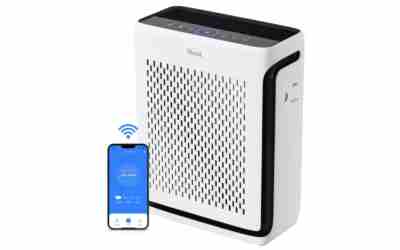
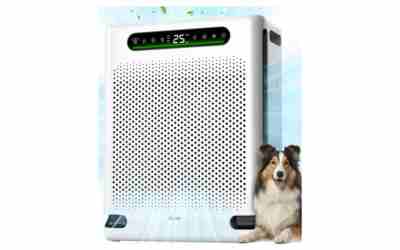
LEVOIT Core 300-P Air Purifier for Home Allergies, Pets, Smoke, H13 True HEPA Filter, 24dB Sleep Mode, Covers 1073 sq ft, AHAM Verifide, White

WINIX 5510 Air Purifier for Large Rooms up to 1,882 sq ft, True HEPA, Smart App & Auto Mode, Captures Pet Allergies & Smoke

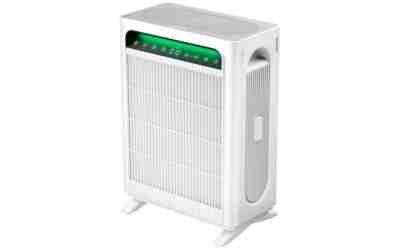
PuroAir 240 HEPA Air Purifier for Home Pets - Covers 1000 sq ft with Auto and Sleep Modes, HEPA + CarbonTech Filter
As an Amazon Associate we earn from qualifying purchases. Product prices and availability are accurate as of the date/time indicated.
Frequently Asked Questions
Does an air purifier use power when it is turned off?
A unit with a physical off switch or one that is unplugged uses none. Models that go to a standby state with Wi-Fi or a display on keep a small draw, often a watt or two. A plug-in watt meter shows your exact number.
Will an air purifier overload my circuit?
No. A 100-watt purifier draws under 1 amp at 120 volts (100 ÷ 120 = 0.83 A), while a standard 15-amp circuit is rated for 1,800 watts. It only matters if the circuit is already heavily loaded by heaters or other large appliances.
Does auto mode use less electricity than a fixed speed?
Usually, yes. Auto mode lowers the fan when its sensor reads clean air, so it spends more time on low speeds than a unit left on high. The sensor itself adds only a very small draw.
Do HEPA purifiers with UV or ionizer use more watts?
Slightly. A UV lamp adds a few watts while lit, and an ionizer adds little. The bigger concern is that ionizers can produce ozone, so use that feature only if the manual says it is safe, or turn it off.
{“@context”: “https://schema.org”, “@type”: “FAQPage”, “mainEntity”: [{“@type”: “Question”, “name”: “Does an air purifier use power when it is turned off?”, “acceptedAnswer”: {“@type”: “Answer”, “text”: “A unit with a physical off switch or one that is unplugged uses none. Models that go to a standby state with Wi-Fi or a display on keep a small draw, often a watt or two. A plug-in watt meter shows your exact number.”}}, {“@type”: “Question”, “name”: “Will an air purifier overload my circuit?”, “acceptedAnswer”: {“@type”: “Answer”, “text”: “No. A 100-watt purifier draws under 1 amp at 120 volts (100 ÷ 120 = 0.83 A), while a standard 15-amp circuit is rated for 1,800 watts. It only matters if the circuit is already heavily loaded by heaters or other large appliances.”}}, {“@type”: “Question”, “name”: “Does auto mode use less electricity than a fixed speed?”, “acceptedAnswer”: {“@type”: “Answer”, “text”: “Usually, yes. Auto mode lowers the fan when its sensor reads clean air, so it spends more time on low speeds than a unit left on high. The sensor itself adds only a very small draw.”}}, {“@type”: “Question”, “name”: “Do HEPA purifiers with UV or ionizer use more watts?”, “acceptedAnswer”: {“@type”: “Answer”, “text”: “Slightly. A UV lamp adds a few watts while lit, and an ionizer adds little. The bigger concern is that ionizers can produce ozone, so use that feature only if the manual says it is safe, or turn it off.”}}]}