
To choose an air purifier, start with your room size: pick a unit whose smoke CADR is at least two-thirds of the room’s square footage, with a true HEPA filter and noise levels you can live with. Then match the filter type to your problem, such as allergies, pets, smoke or odors, and check what replacement filters cost.
Start with room size and CADR
CADR (clean air delivery rate) is the number that tells you how fast a purifier cleans air. It is measured in cubic feet per minute (CFM) for smoke, pollen and dust, and a higher number means faster cleaning. The common AHAM rule of thumb: the smoke CADR should be at least two-thirds of the room’s floor area, assuming ceilings of about 8 feet. That works out to roughly five full air changes per hour.
| Room size | Minimum smoke CADR (2/3 rule) |
|---|---|
| 100 sq ft (small bedroom) | about 67 |
| 200 sq ft (average bedroom) | about 133 |
| 300 sq ft (large bedroom) | about 200 |
| 400 sq ft (living room) | about 267 |
| 500 sq ft (open living area) | about 333 |
Adjust for your space. If your ceilings are 9 or 10 feet, go up a size. If the room opens into a hallway or kitchen with no door, size for the combined space or accept slower cleaning. Also read the coverage claim on the box carefully. Some brands list a large square footage that assumes only one or two air changes per hour, which is much slower than the two-thirds rule. The CADR figure, not the marketing square footage, is the better comparison point.
Insist on a true HEPA filter
A true HEPA filter is rated to capture at least 99.97% of particles 0.3 microns in size, which covers fine dust, pollen, mold spores, pet dander and much of the particle content in smoke. Labels such as “HEPA-type,” “HEPA-like” or “99% filtration” do not carry the same guarantee, so look for the words “True HEPA” or “H13” in the specs.
Most good purifiers use a layered filter:
- Pre-filter: catches hair, lint and large dust so the HEPA layer lasts longer. Many are washable or vacuumable.
- True HEPA: handles the fine particles.
- Activated carbon: adsorbs odors and some gases. This only works well in meaningful amounts, so a thin, black mesh sheet will do far less than a thick carbon bed. Check the manufacturer’s listed carbon weight if odors or smoke are your concern.
Particle filters do not remove everything. Carbon-based filters help with smells and some volatile compounds, but how well they work depends on the model and the pollutant. Fixing the source, such as ventilating while you cook, is usually more effective than filtering it later.
Match the filter to your problem
The right purifier depends on what you are trying to remove. Use this as a short guide:
- Allergies and dust: prioritize a true HEPA filter and a CADR sized to the bedroom. Our list of the best air purifiers for allergies narrows down the options.
- Pets: look for a washable pre-filter for hair and a carbon layer for odors. See our picks of the best air purifiers for pets.
- Wildfire or cooking smoke: get a high smoke CADR and a substantial carbon filter. Compare the best air purifiers for smoke.
- Mold: a purifier can capture airborne spores, but it will not stop mold growing on a wet surface. Fix the moisture source first. Our guide to the best air purifiers for mold covers what to expect.
If you have asthma or another medical condition, ask your doctor what level of air cleaning makes sense. A purifier is a supplement to, not a replacement for, medical care.
Check noise, filter costs and power use
The purifier that works best is the one you actually leave running. Three things decide that.
Noise
Manufacturers usually list decibel levels at the lowest and highest fan settings. For a bedroom, the low setting is what matters, and many people look for roughly 25 to 30 dB or less there. Keep in mind that the highest CADR is only reached at the highest speed, which is typically much louder. A larger unit running at a lower speed is often quieter than a small unit running flat out.
Filter replacement
Replacement HEPA filters are the main ongoing cost. Many manufacturers suggest changing them every 6 to 12 months, though the interval depends on the model and how dirty your air is. Before buying, look up the price of the replacement filter and divide it by its stated life. Some units use a filter-change indicator based on run time rather than actual air quality, so use it as a reminder, not a measurement.
Power use
Most home purifiers draw modest power, but they run for many hours a day. Check the wattage on the spec sheet and look for ENERGY STAR certification if it matters to you. Actual cost depends on your local electricity rate and fan speed.
Avoid ozone and think about ionizers
Ozone is a lung irritant, and you do not want a purifier that produces it. Some “ionizing” or “electronic” air cleaners can emit ozone as a byproduct. In California, air cleaners sold in the state must meet CARB ozone limits, so a CARB certification listing is a useful check anywhere in the US. Filter-based purifiers with no ionizer, or with an ionizer you can turn off, are the safer starting point.
If electromagnetic emissions matter to you, look for a model with simple controls and no wireless features, or review our roundup of the best low EMF air purifiers. Smart features like Wi-Fi apps are convenient for scheduling and monitoring, but they are optional, and the filter matters more than the app.
Placement and how to run it
Even the right purifier underperforms if it is boxed in. Follow these steps for better results:
- Leave several inches of clear space around the unit. Check the manual for the exact distance for your model.
- Place it in the room where you spend the most time, usually the bedroom, a few feet from the bed.
- Keep doors and windows closed while it runs, so it is cleaning the same air repeatedly.
- Run it continuously on a low or auto setting. Turn it up when you vacuum, cook, or when outdoor smoke is high.
- Replace or clean filters on schedule. A clogged filter lowers airflow and cleaning performance.
A common mistake is buying one unit for a whole house. A single purifier works best in a single room, so prioritize the bedroom first and add more units as your budget allows.
Models worth comparing
Once you know your CADR target, compare a few specific models against it. Specs vary by model and by year, so confirm the CADR, filter type and replacement cost on the manufacturer’s page before you buy. Our broader picks are in the best air purifier for home roundup. If you prefer to read individual reviews, these are good places to start:
- LEVOIT Core 300-P review for small rooms and bedrooms.
- Levoit Core 200S quiet review if you want a compact smart model.
- LEVOIT Vital 200S-P review for larger rooms with smart controls.
- Coway Airmega Mighty2 review for a mid-size room.
Whichever you choose, the formula stays the same: the right CADR for your room, true HEPA, the carbon you need, a noise level you will tolerate, and filters you can afford to replace.
Our Top Picks
Ready to shop? These are the top-rated options from our hands-on roundup, Best Air Purifier For Home of 2026.

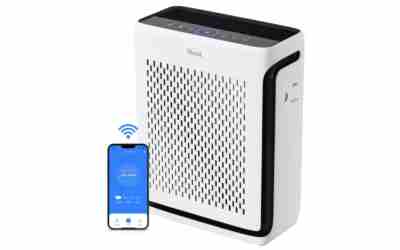
LEVOIT Vital 100S-P Air Purifier for Home, Pets, and Bedroom, Up to 1073 Sq Ft, HEPA Sleep Mode, Washable Pre-Filter, Smart Air Quality Monitor, White

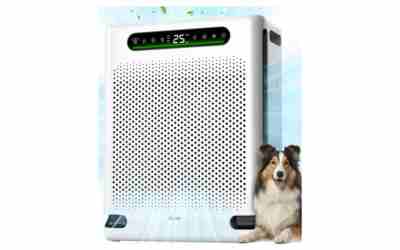
KNKA APH4000 Air Purifier for Home Bedroom, HEPA Sleep Mode Air Cleaner with Washable Pre-Filter, AHAM Verified, AQI Display, Pet Mode for Pet Dander, Dust & Pollen, Up to 1,695 Sq Ft, White

FreAire HAP605 Air Purifier for Large Rooms
As an Amazon Associate we earn from qualifying purchases. Product prices and availability are accurate as of the date/time indicated.
Frequently Asked Questions
What size air purifier do I need for my room?
Multiply your room’s square footage by two-thirds to get the minimum smoke CADR, assuming 8-foot ceilings. A 300 sq ft room needs a CADR of about 200. Go higher for taller ceilings or open floor plans.
Is HEPA the only filter I need?
True HEPA handles fine particles like dust, pollen, dander and mold spores. It does not remove odors or most gases. For smells, smoke or cooking fumes, choose a unit with a substantial activated carbon filter as well.
How often should I replace air purifier filters?
Many manufacturers recommend replacing HEPA filters every 6 to 12 months, and carbon filters sometimes sooner. The actual interval depends on the model, run time and how much dust, smoke or pet hair is in your home. Check your manual.
Are ionizer air purifiers safe?
Some ionizers can produce ozone, which irritates the lungs. Choose filter-based purifiers, or models where the ionizer can be turned off. In the US, a CARB certification is a helpful sign that ozone emissions are within limits.