Yes, you can use a toaster oven as a dehydrator, but only if it can hold a steady 135-170°F. Below that range you need a low setting; above it, food cooks instead of drying. This guide shows how to test your oven, set it up, pick temperatures for fruit, herbs and jerky, and handle the USDA meat-safety step.
When a toaster oven as a dehydrator works, and when it doesn’t
A dehydrator does two things: it holds low heat and it moves dry air across the food. A toaster oven can do the first if its lowest setting is low enough, and it can fake the second with a convection fan or a propped door.
The deciding number is your oven’s real minimum temperature. Many toaster ovens bottom out around 150-200°F, and that varies by model, so check the manual. University of California extension guidance is to keep an oven under 200°F, and notes that if it can’t go low enough, food cooks rather than dries.
- Lowest real temp 170°F or under: good for fruit, vegetables and jerky.
- Lowest real temp 171-200°F: only for jerky or thin, tough items, with the door open and a close watch. Fruit will cook and scorch at the edges.
- Lowest real temp over 200°F: not suitable. Buy a dehydrator or use a different method.
Some air fryer toaster ovens include a dehydrate mode with its own low range and fan. Our Ninja SP101 digital air fry oven review covers one such style of oven. Check the manual of any model for its exact dehydrate range and door instructions.
How to test your toaster oven’s real low temperature
Dial and digital readouts can be off by 25°F or more, so don’t trust the setting. A leave-in oven thermometer takes the guesswork out; see our best leave-in oven thermometer picks.
- Place the thermometer on the middle rack, away from the heating elements.
- Set the oven to its lowest temperature (or “warm”) and turn the fan on if it has one.
- Close the door and wait 30 minutes. Note the reading.
- Prop the door open as you would for drying (see next section) and wait another 30 minutes. Note the reading again.
- Check twice more over an hour. Toaster oven elements cycle on and off, so the temperature swings.
Decision rule: if the door-ajar reading stays between 135°F and 170°F, you can dry food. If it hovers above 170°F, treat the oven as jerky-only. If it falls below 130°F with the door open, close the door partway until it recovers.
How to set up a toaster oven for dehydrating, step by step
- Prep thin, even pieces. Slice fruit and vegetables about 1/8 to 1/4 inch thick. Uneven slices dry unevenly.
- Line the pan. Use a wire rack set over a baking sheet, or the oven’s own wire rack with parchment under it to catch drips. Don’t block the whole rack with a solid pan; air needs to reach the underside.
- Arrange in a single layer with small gaps. Pieces that touch dry slowly and stick.
- Set the lowest temperature that your thermometer test says works, and turn on convection if you have it.
- Vent moisture. Ovens lack the top vent a dehydrator has, so moist air stays in. For a non-convection oven, UC extension suggests propping the door open about 2-6 inches. In a small toaster oven, start with 1-2 inches and widen only if the temperature allows.
- Rotate and flip. Turn the pan and flip pieces every 1-2 hours, since toaster ovens heat unevenly.
- Check for dryness by cooling a piece to room temperature first. Warm food always feels softer than it is.
If your oven has a built-in dehydrate function, follow the manual instead. Those modes are designed to run with the door closed, and propping the door open can trigger errors or shut-offs.
What temperature and how long for fruit, herbs and jerky?
These are starting points, not promises. Time depends on slice thickness, humidity and how accurately your oven holds heat. UC extension notes oven drying takes about twice as long as a dehydrator, so budget accordingly.
| Food | Target temp | Rough time range | Done when |
|---|---|---|---|
| Apple or pear slices | 135-150°F | 6-12+ hours | Leathery, no moist spots when torn |
| Bananas, strawberries | 135-150°F | 6-12 hours | Pliable or crisp, no sticky centers |
| Tomatoes, mushrooms, peppers | 125-145°F | 5-10 hours | Leathery to brittle |
| Herbs | As low as the oven allows | 1-4 hours | Leaves crumble easily |
| Jerky (after the heat step) | 140-170°F | 3-8 hours | Bends and cracks, doesn’t snap |
Most guides recommend roughly 120-140°F for general drying, but a toaster oven’s floor often keeps you at the higher end. Higher heat is fine for sturdy fruit if you watch it. Delicate herbs are the weak spot: they prefer well under 115°F, which most toaster ovens can’t reach. Use the lowest setting with the door open for short checks, or air-dry herbs instead.
How to make jerky safely in a toaster oven
Low drying heat alone does not make jerky safe. USDA guidance is to heat meat to 160°F (poultry to 165°F) as part of the process, either before drying or during it, then dry it. Dehydrators and toaster ovens that sit at 130-140°F can let bacteria survive if you skip this step.
- Use lean meat, trim visible fat, and slice about 1/4 inch thick. Marinate in the refrigerator, never on the counter.
- Heat the strips to 160°F (165°F for poultry). Simmer them in the marinade for a few minutes, or bake them at about 275°F, until a food thermometer reads the right temperature in the thickest piece.
- Arrange strips on a rack in a single layer without touching.
- Dry at 140-170°F with the door ajar and the fan on if available, until a cooled piece bends and cracks without snapping.
- Blot off any fat, cool, and store in an airtight container. Refrigerate for longer storage.
If your oven’s low setting is already 160-170°F, you may meet the heat target while drying, but verify with a food thermometer in the meat rather than assuming. For gear built for larger jerky batches, see our best home dehydrator for jerky.
Toaster oven vs. dehydrator: capacity, energy and evenness
The honest tradeoffs: a toaster oven works for a small batch now, but a dehydrator is better if you dry food regularly.
| Toaster oven | Dehydrator | |
|---|---|---|
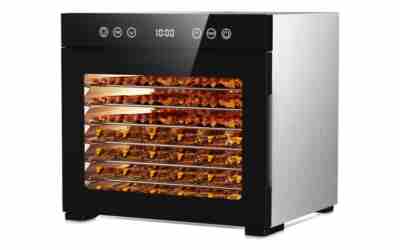
| Capacity | Usually one rack or pan (roughly one 9×13 pan of apple slices, depending on model) | Often 4-9 stackable trays |
| Airflow | Convection fan or door ajar | Built-in fan and vent |
| Even drying | Hot spots near elements; needs rotating | More even, less turning |
| Lowest temp | Often 150°F+ (model dependent) | Typically adjustable down to about 95-105°F |
| Time | About twice as long (UC extension) | Baseline |
Energy example (illustrative, check your own label and rates): a toaster oven rated at 1,500 watts that runs its element about half the time uses roughly 0.75 kW on average. Over 8 hours that is about 6 kWh, or about $1 at 17 cents per kWh. Many dehydrators draw less, often a few hundred watts, though wattage varies, so check the label. The cost is small for an occasional batch, but it adds up and the oven also dumps heat into your kitchen.
Choose the toaster oven if you dry food a few times a year, in small batches, and your oven passes the temperature test. Choose a dehydrator if you make jerky or fruit often, want herbs, or need more than one pan at a time. A budget unit is enough for most people; compare options in our best affordable dehydrator guide or read the NESCO FD-75A Snackmaster Pro review. If you want a toaster oven that handles more modes, see our best toaster oven roundup.
Safety checklist and common mistakes
- Don’t leave it running unattended for hours with the door propped. Stay home, and check every hour or two.
- Plug directly into a wall outlet, not an extension cord. Check your manual for continuous-use limits.
- Keep clearance. Move the oven away from curtains, cabinets and paper. Hot air escapes from the open door.
- Protect kids and pets. An open toaster oven door gets hot and can tip the unit if leaned on.
- Prop the door with a heat-safe item, never towels, wood or anything near the elements. Some doors won’t stay ajar; don’t force them.
- Don’t trust the dial. Verify with an oven thermometer.
- Don’t pull food early. Moisture left inside lets mold grow in storage. If in doubt, dry longer and cool before testing.
- Don’t skip the jerky heat step. Drying is not the same as cooking meat to a safe temperature.
If you want a single appliance that bakes, air fries and sometimes dehydrates, our best combination oven guide is a good next step.
Our Top Picks
Ready to shop? These are the top-rated options from our hands-on roundup, Best Toaster Oven of 2026.

Emeril Lagasse 26QT French Door Air Fryer Toaster Oven with 24 Cooking Functions, Dual-Speed Fan, and Rotisserie

Cuisinart TOA-70NAS Air Fryer Toaster Oven

Nuwave Bravo XL Pro Air Fryer Toaster Oven 30QT
As an Amazon Associate we earn from qualifying purchases. Product prices and availability are accurate as of the date/time indicated.
Frequently Asked Questions
Can an air fryer toaster oven replace a food dehydrator?
Only if it has a true low-temperature dehydrate mode or holds 135-170°F in your thermometer test. Most air fryer settings run too hot and too short. Even with dehydrate mode, capacity is smaller than a tray dehydrator, so expect small batches.
Is it safe to run a toaster oven for 8-12 hours?
Only if the manufacturer’s manual allows long runs, and only while you’re home and checking on it. Many toaster ovens have auto shut-off timers that stop at 1-2 hours. Never run one unattended with the door propped open.
How long does it take to dry fruit in a toaster oven?
Expect roughly 6-12 hours or more for 1/4-inch fruit slices, often about twice the dehydrator time per UC extension. Thickness, humidity and your oven’s real temperature change this, so judge by texture, not the clock.
What if my toaster oven’s lowest setting is 200°F?
Use it only for jerky after the USDA heat step, with the door open, or skip it. At 200°F, fruit and vegetables cook and scorch rather than dry. A small dehydrator is a better investment than fighting the oven.
{“@context”: “https://schema.org”, “@type”: “FAQPage”, “mainEntity”: [{“@type”: “Question”, “name”: “Can an air fryer toaster oven replace a food dehydrator?”, “acceptedAnswer”: {“@type”: “Answer”, “text”: “Only if it has a true low-temperature dehydrate mode or holds 135-170°F in your thermometer test. Most air fryer settings run too hot and too short. Even with dehydrate mode, capacity is smaller than a tray dehydrator, so expect small batches.”}}, {“@type”: “Question”, “name”: “Is it safe to run a toaster oven for 8-12 hours?”, “acceptedAnswer”: {“@type”: “Answer”, “text”: “Only if the manufacturer’s manual allows long runs, and only while you’re home and checking on it. Many toaster ovens have auto shut-off timers that stop at 1-2 hours. Never run one unattended with the door propped open.”}}, {“@type”: “Question”, “name”: “How long does it take to dry fruit in a toaster oven?”, “acceptedAnswer”: {“@type”: “Answer”, “text”: “Expect roughly 6-12 hours or more for 1/4-inch fruit slices, often about twice the dehydrator time per UC extension. Thickness, humidity and your oven’s real temperature change this, so judge by texture, not the clock.”}}, {“@type”: “Question”, “name”: “What if my toaster oven’s lowest setting is 200°F?”, “acceptedAnswer”: {“@type”: “Answer”, “text”: “Use it only for jerky after the USDA heat step, with the door open, or skip it. At 200°F, fruit and vegetables cook and scorch rather than dry. A small dehydrator is a better investment than fighting the oven.”}}]}