
Yes, tea kettles go bad, wearing out from leaks, rust, flaking enamel or electrical faults, and electric models usually fail first.
Do tea kettles go bad, and how long do they last?
A kettle has no expiration date, but the parts inside and around it wear out. Heating elements, switches, seals, seams and coatings all age with heat, water and daily use, and a kettle “goes bad” when one of those parts stops doing its job safely.
As typical values, an electric kettle lasts about 3 to 5 years and a stovetop kettle about 5 to 10 years. Budget models can fail within months, and a well-kept kettle can outlast these ranges. Stovetop kettles have no electronics, which is why they usually outlive electric ones.
The first parts to give out differ by type. On an electric kettle it is usually the switch, thermostat, heating element, base contacts or seals. On a stainless stovetop kettle it is the whistle, handle rivets, seam or a scorched bottom. On an enamel-coated kettle it is the enamel at the spout, rim and bottom. On bare cast iron it is the interior surface, which rusts if left damp.
Hard water shortens the life of every type. Scale on an electric element makes the kettle work harder, and mineral crust on a stovetop bottom traps heat and speeds up scorching.
Signs your tea kettle has gone bad
Run through this list before your next boil. Any “replace” result means the kettle has reached the end of its life.
| Check | Applies to | Result |
|---|---|---|
| Water seeping from the seam, spout or base | All kettles | Replace |
| Rust, pitting or flaking inside | All kettles | Replace |
| Enamel chipped down to bare metal inside | Enamel stovetop | Replace |
| Frayed, hot, loose or sparking cord or plug | Electric | Replace |
| Cracked, corroded or scorched base | Electric | Replace |
| Keeps steaming and rumbling after a full boil, or you have to flip the switch yourself (test: fill to the minimum line, start it and watch) | Electric | Replace |
| Burnt smell or loud rattling that continues after descaling | Electric | Replace |
| Loose handle or wobbly lid hinge | All kettles | Replace (burn risk) |
| Bottom burned through or warped so it rocks on the burner | Stovetop | Replace |
| Slow boiling | Electric | Descale first; replace if still slow after one descale |
| White or gray crust on the bottom or element | All kettles | Pass: descale it |
| Small cosmetic dent or outside scuff | All kettles | Pass if nothing leaks |
A healthy electric kettle switches itself off within moments of a full boil. If yours does not, stop using it.
Is limescale harmful, and how do you descale a kettle?
Limescale is mostly calcium and magnesium left behind by hard water. It is not a health hazard, but it insulates the element or bottom, slows boiling, makes noise and can clog a spout filter. Scale alone is a cleaning job, not a reason to replace the kettle.
Check your manual first. Some makers specify a particular descaler or warn against vinegar on certain finishes, such as aluminum or some enamel and coatings. If the manual is silent, this is the usual method:
- Unplug the kettle (electric) and let it cool. Never put the base in water.
- Fill it about half full with equal parts white vinegar and water, or use a citric acid solution mixed as the label directs.
- Bring it to a boil, turn it off, and let it sit about 20 minutes.
- Pour it out and loosen leftover flakes with a soft brush or sponge. Skip steel wool on enamel and non-stick surfaces.
- Fill with fresh water, boil, and discard. Repeat once if you still smell vinegar.
Use this schedule as a starting point. Find your hardness in your utility’s water quality report or with test strips.
| Water hardness (mg/L) | Category | Descale about every |
|---|---|---|
| 0 to 60 | Soft | 3 months |
| 61 to 120 | Moderate | 2 months |
| 121 to 180 | Hard | 1 month |
| Over 180 | Very hard | 2 to 3 weeks |
Is it safe to boil water in a rusty kettle?
It depends on what you are seeing, so rinse and descale first and then judge.
- Brown or orange stain that wipes or descales away: usually mineral or iron deposits from the water, and the kettle is fine.
- Rust that comes back after cleaning, or rough orange patches: the protective surface is breaking down, so it is time to replace the kettle.
- Dark, charred-looking flecks or coating that rubs off on your finger: stop boiling water in it, because those flakes end up in your cup.
Rust is more a taste and durability problem than an acute poison, but flaking material does not belong in drinking water. When in doubt, replace it.
Bare cast iron needs the most attention because it rusts quickly if left damp. Dry it right after every use, and keep the lid off while it air-dries.
Handling an aging electric kettle safely
Electric kettles combine water, heat and mains power, so a few habits matter as the kettle gets older.
- Do not open the housing or splice a cord yourself. Replace the kettle unless the manufacturer sells an approved base or cord set.
- Use only the base that came with the kettle, since bases and kettles are matched sets.
- Unplug it before cleaning, and wipe the base and contacts dry so mineral buildup does not cause arcing or intermittent heating.
If the kettle trips a breaker or the outlet feels warm, unplug it and stop using it.
Repair, descale or replace: a one-line rule
Descale for slow boiling, noise or white crust, and replace for every “replace” result in the checklist; a stovetop whistle, lid knob or handle screw can be swapped only if the maker sells the part.
How to make a kettle last longer
- Fill between the minimum and maximum lines, and never run it empty.
- Use filtered water if your water is hard or very hard.
- Keep the cord loose, away from the hot spout and out of tight bends.
- Empty and dry the kettle after use, and clean enamel with a soft sponge so the coating stays intact.
Our Top Picks
Ready to shop? These are the top-rated options from our hands-on roundup, Best Induction Tea Kettle of 2026.

WALDWERK 1.5 Quart Stainless Steel Whistling Kettle

Gipfel International 2.3 Quart Stainless Steel Whistling Kettle
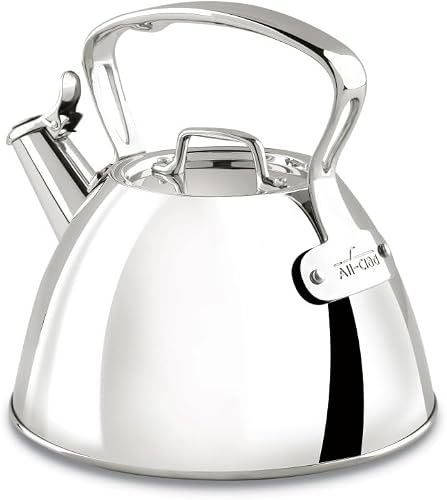
All-Clad 2 Qt Stainless Steel Tea Kettle
As an Amazon Associate we earn from qualifying purchases. Product prices and availability are accurate as of the date/time indicated.
Related reading: The Best Tea Tumbler with Infuser of 2026
Related reading: How to Descale a Tea Kettle With Vinegar or Citric Acid
Frequently Asked Questions
Can I use a kettle with a small crack in the lid?
Yes, if the lid stays intact, sheds no pieces and the crack does not reach the hinge or seal. Replace the lid or the kettle once the crack spreads or bits fall into the water.
Is a kettle with white flakes safe?
Usually. Scale crumbles between your fingers and dissolves in vinegar or citric acid, so descale and rinse. Flakes that do not dissolve are coating, and the kettle should be retired.
Can I use a kettle after it boiled dry?
Unplug it or take it off the heat and let it cool completely first. If it looks normal, smells normal and still shuts off, it is usable. Discoloration, melted plastic, a burnt smell or a warped bottom means replace it.
Does a kettle go bad if I never use it?
It will not expire, but water left inside can leave scale or rust. Empty it, dry it completely and check it against the checklist before the first boil after a long break.
{“@context”: “https://schema.org”, “@type”: “FAQPage”, “mainEntity”: [{“@type”: “Question”, “name”: “Can I use a kettle with a small crack in the lid?”, “acceptedAnswer”: {“@type”: “Answer”, “text”: “Yes, if the lid stays intact, sheds no pieces and the crack does not reach the hinge or seal. Replace the lid or the kettle once the crack spreads or bits fall into the water.”}}, {“@type”: “Question”, “name”: “Is a kettle with white flakes safe?”, “acceptedAnswer”: {“@type”: “Answer”, “text”: “Usually. Scale crumbles between your fingers and dissolves in vinegar or citric acid, so descale and rinse. Flakes that do not dissolve are coating, and the kettle should be retired.”}}, {“@type”: “Question”, “name”: “Can I use a kettle after it boiled dry?”, “acceptedAnswer”: {“@type”: “Answer”, “text”: “Unplug it or take it off the heat and let it cool completely first. If it looks normal, smells normal and still shuts off, it is usable. Discoloration, melted plastic, a burnt smell or a warped bottom means replace it.”}}, {“@type”: “Question”, “name”: “Does a kettle go bad if I never use it?”, “acceptedAnswer”: {“@type”: “Answer”, “text”: “It will not expire, but water left inside can leave scale or rust. Empty it, dry it completely and check it against the checklist before the first boil after a long break.”}}]}