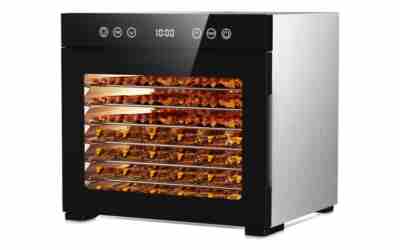
Cheap food dehydrators, typically $30-$70, work for fruit, herbs and small jerky batches, provided the unit has an adjustable thermostat and even airflow.
Where cheap food dehydrators work and where they struggle
A dehydrator is a low-wattage heating element, a fan and a stack of trays. Budget units use the same three parts as expensive ones. What you give up is usually airflow design, temperature control, tray capacity and plastic quality.
That makes cheap units a good fit for forgiving foods and small loads. They struggle with long runs, full loads and anything where a few degrees matter for safety.
| Food | Target dehydrator temperature | Source |
|---|---|---|
| Herbs | 95-115°F | National Center for Home Food Preservation |
| Fruit and vegetables | 125-135°F | National Center for Home Food Preservation |
| Jerky (after the meat is heated to a safe temperature) | 130-140°F | USDA |
Fixed-temperature units usually sit near the fruit and vegetable range. That is fine for apples and tomatoes, but too hot for delicate herbs and not guaranteed for jerky. Plastic bodies are also the common weak point: the fans and elements tend to hold up better than the housings, and many budget units are loud.
Pass/fail checklist for any cheap dehydrator
Check these before you trust a $30-$70 unit. Two or more fails means skip it.
- Adjustable thermostat: pass if the dial or display covers at least 95°F to 140°F. Fail if there is a single fixed temperature, because you cannot dry herbs gently or hold jerky temperatures.
- Fan placement: a rear-mounted fan pushing air sideways across every tray is the best layout. A base or top fan on round stacked units works, but expect to rotate trays.
- Wattage: higher wattage only helps if the fan moves air evenly. Treat wattage as a tiebreaker, not a quality score.
- Tray count and spacing: four or more trays with at least an inch of gap each. Cramped trays block airflow.
- Food-safe trays: look for BPA-free labeling and trays that lift out without warping.
- Timer or auto shut-off: a pass if present. Without one, you must be home to stop it.
Is jerky safe in a cheap dehydrator?
Yes, but not by relying on the dehydrator alone. USDA guidance is to heat meat to 160°F for beef (165°F for poultry) before or during drying, because many home units never reach that internal temperature on their own.
- Marinate the strips, then heat them in a 275°F oven or in simmering marinade until a thermometer reads 160°F (165°F for poultry).
- Move the strips to the trays and dry at the 130-140°F range from the table above.
- Put a stand-alone oven thermometer on a middle tray to confirm the unit actually holds that range.
- Dry until a cooled strip bends and cracks without snapping. Store it airtight.
Drying time depends on strip thickness and the model, so judge by texture, not the clock. If you make jerky often, our jerky dehydrator comparison covers units built for it.
How to test a cheap dehydrator for even drying
Reviews rarely measure this, but you can in one afternoon with a kitchen scale.
- Slice apples to a uniform 1/4 inch.
- Weigh equal portions per tray, for example 8 oz, and load every tray.
- Run at 130°F with no solid liners, since sheets can block the airflow. Our guide on using parchment paper in a dehydrator explains which kinds are safe.
- After 4 hours, pull one tray at a time and weigh it, then compare.
Illustration only, not a measured result: if the top tray weighs 3.0 oz and the bottom tray 4.5 oz, the gap is 1.5 oz, or about 33% of the heavier tray.
Decision rule: if the lightest and heaviest trays differ by more than 25%, rotate trays every hour. If the gap is 25% or less, rotating every 1-2 hours is enough.
To rotate, swap top and bottom trays and turn each tray 180 degrees. Keep loads to a single layer with gaps between pieces. Overloading is the most common reason a good unit dries badly.
Do cheap dehydrators beat an oven or air fryer?
For fruit and herbs, usually yes. Many ovens will not hold below about 170°F, which cooks fruit instead of drying it, and they burn far more power over a 10-hour run. Propping the door open helps only a little and wastes heat.
An air fryer with a dehydrate setting works for one small tray, which is fine for a handful of herbs. A toaster oven is another option if it has a low setting and a convection fan; see how a toaster oven works as a dehydrator for the limits. Sun drying only suits hot, dry, low-humidity climates and is not reliable for meat.
When paying more for a dehydrator is worth it
Spend more if you will run full loads, dry jerky weekly or need quiet operation. Mid-range box-style units add a rear fan, a wider temperature range and a sturdier shell. The NESCO FD-75A Snackmaster Pro review shows what a step up looks like.
Price does not set drying speed. Food thickness and moisture matter more, so a pricier unit will not dry thick slices faster.
- Buy cheap if: you dry small batches a few times a year and mostly make fruit chips or herbs.
- Skip cheap if: it has no thermostat, you plan on jerky, or you want 6+ trays running at once.
Our Top Picks
Ready to shop? These are the top-rated options from our related roundup, Best Food Dehydrator for Deer Jerky of 2026.

PSIIDAN FD-1033 8-Tray 650W Food Dehydrator

Cosori Food Dehydrator 6 Tray 600W
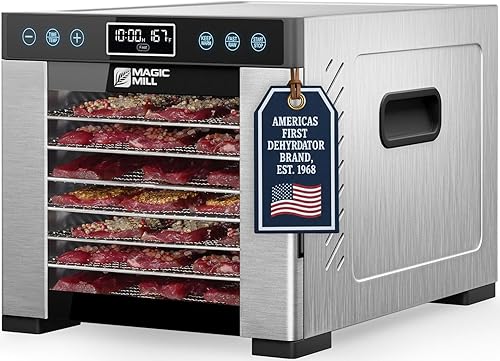
Magic Mill MFD-7700 7-Tray Stainless Steel Dehydrator
As an Amazon Associate we earn from qualifying purchases. Product prices and availability are accurate as of the date/time indicated.
Frequently Asked Questions
Can I dry herbs and jerky in the same batch?
No. Herbs need much lower heat than jerky, and strong meat and marinade smells transfer to herbs and fruit. Run them separately, and wipe the trays between batches.
Is a $30 dehydrator safe for jerky?
Yes, if it has an adjustable thermostat that reaches 130-140°F and you first heat the meat to 160°F (165°F for poultry). Skip any unit with a single fixed temperature.
Why is my cheap dehydrator drying unevenly?
Usually weak airflow, overloaded trays or pieces that overlap. Use a single layer with gaps, and rotate trays every hour if the weigh test shows more than a 25% difference.
Is a dehydrator cheaper to run than an oven?
Yes. A typical budget dehydrator draws about 300-600W, while a full-size oven draws roughly 2,000-5,000W. Over a long drying run the dehydrator uses far less electricity.
{“@context”: “https://schema.org”, “@type”: “FAQPage”, “mainEntity”: [{“@type”: “Question”, “name”: “Can I dry herbs and jerky in the same batch?”, “acceptedAnswer”: {“@type”: “Answer”, “text”: “No. Herbs need much lower heat than jerky, and strong meat and marinade smells transfer to herbs and fruit. Run them separately, and wipe the trays between batches.”}}, {“@type”: “Question”, “name”: “Is a $30 dehydrator safe for jerky?”, “acceptedAnswer”: {“@type”: “Answer”, “text”: “Yes, if it has an adjustable thermostat that reaches 130-140°F and you first heat the meat to 160°F (165°F for poultry). Skip any unit with a single fixed temperature.”}}, {“@type”: “Question”, “name”: “Why is my cheap dehydrator drying unevenly?”, “acceptedAnswer”: {“@type”: “Answer”, “text”: “Usually weak airflow, overloaded trays or pieces that overlap. Use a single layer with gaps, and rotate trays every hour if the weigh test shows more than a 25% difference.”}}, {“@type”: “Question”, “name”: “Is a dehydrator cheaper to run than an oven?”, “acceptedAnswer”: {“@type”: “Answer”, “text”: “Yes. A typical budget dehydrator draws about 300-600W, while a full-size oven draws roughly 2,000-5,000W. Over a long drying run the dehydrator uses far less electricity.”}}]}