
An induction cooktop is worth it if you cook most days and can add a 240-volt circuit, but skip it if you rent or rely on a round-bottom wok. Your current stove, your pots and your electrical quote decide the rest, and the worksheet below puts a number on it.
What you gain with induction
Induction heats the pan itself with a magnetic field, so the glass never has to get hot first. Nearly every benefit comes from that one design choice.
- Speed: water comes to a boil faster than on radiant electric, because little heat is wasted on the air around the pot.
- Control: power changes the moment you adjust the setting, so a sauce drops from a boil to a simmer without a lag.
- Efficiency: commonly cited figures put induction at about 84 to 90 percent of energy reaching the pan, radiant electric at 70 to 80 percent and gas at roughly 32 to 40 percent.
- Cleanup: spills don’t bake on, since the glass is only warmed by the pan.
- Safety: there is no flame, and a burner with no pot on it does not heat. The glass still holds some residual heat, so watch the hot-surface light.
Induction burns nothing at the cooktop, but cooking still makes grease and smoke. Run the hood either way.
Induction vs gas vs radiant electric on everyday tasks
| Task | Induction | Gas | Radiant electric |
|---|---|---|---|
| Boiling water | Fastest of the three in most comparisons | Fast, but flame heat escapes around the pot | Slowest, since the element must heat first |
| Searing | Strong and instant with a flat, heavy pan | Strong, and the flame reaches up the pan sides | Good once hot, but slow to recover after food goes in |
| Simmering | Steady low power with fine steps | Stable, though the lowest flame can be too high on some burners | Element cycles on and off and reacts slowly |
| Round-bottom wok | Needs a flat or induction-specific wok | Best fit | Needs a flat-bottom wok |
| Glass after the pan is removed | Warm only from the pan’s heat | No glass, open flame | Stays hot for a long time |
Test your pots with a magnet
You rarely need a whole new set. Test what you own first.
- Hold a refrigerator magnet to the outside of the pan’s flat bottom, not the side wall.
- A firm pull means the pan works. A weak grip means poor performance, and no grip means it won’t heat.
- Set a ruler across the bottom. A pan that rocks or bows will heat unevenly and may buzz.
- Compare the pan base to the burner ring. Check your manual for the smallest pan the burner will detect, since this depends on the model.
Cast iron, enameled cast iron, carbon steel and magnetic stainless pass. Aluminum, copper, glass and non-magnetic stainless fail unless the base has a magnetic layer or you add an interface disc. Our guide on whether induction cooktops need special pans covers the edge cases.
What switching costs: a worksheet with your own numbers
Get written quotes, then fill in each line.
- A. Cooktop: the price of the model you want.
- B. Electrical: an electrician’s quote for a dedicated 240-volt circuit sized to the installation manual. If you already have an electric range, ask whether the existing circuit fits the new model.
- C. Gas shutoff: a licensed pro’s quote to cap the line if you are leaving gas.
- D. Cookware: the number of pots that failed the magnet test times their replacement cost. A skillet, saucepan and stockpot cover most cooks. See induction cookware options if you need them.
- E. Cutout and trim: any countertop changes, since cutout sizes differ by model.
- F. Rebates: subtract state or utility electrification rebates. Programs, amounts and eligibility vary by state, so check your state energy office and utility.
- G. Like-for-like swap: the cost of the gas or electric cooktop you would buy otherwise.
Your true premium is A + B + C + D + E – F – G.
Example with typical values, not quotes: A $1,800 + B $600 + D $250 = $2,650. Subtract a $1,400 gas replacement for G, and the premium is $1,250. If your gas cooktop costs $60 a year to run and induction costs $50, you save $10 a year, so payback is 125 years. Treat energy savings as a bonus and decide on speed, control and cleanup.
If your home has no gas line, induction avoids the $15 to $25 per linear foot Angi cites for running a new one.
Is an induction cooktop worth it for your kitchen?
Buy if you cook several times a week, your pots pass the magnet test or you have budgeted replacements, and the electrical quote fits your total. Then match it to your situation:
- Coming from coil or glass-top electric: the strongest case, because speed and control improve the most.
- Coming from gas: worth it if you want no combustion at the cooktop and accept the electrician and gas-cap costs. Skip it if you love cooking over flame.
- Renters: skip a built-in and use a plug-in burner.
- Wok cooks: skip, unless you will switch to a flat-bottom or induction-specific wok.
- Tight budget with mostly aluminum or copper pots: wait, since the cookware bill erases the appeal.
- Pacemaker or other implant: ask your doctor and follow the cooktop manufacturer’s guidance before buying.
Know the real trade-offs: some pots hum at high power, there is a short learning curve, it won’t run in a power outage, and dragging pots can scratch the glass. Keep metal utensils and jewelry off the surface, and switch the unit off if the glass cracks.
Try a portable induction burner first
A plug-in single burner is the lowest-risk trial. It needs no electrician, no cutout and no commitment, and it uses your actual pots. Many portable models run on a standard 120-volt outlet, but wattage varies by model, so read the spec label.
Run three tests over a week or two: boil two quarts of water, hold a sauce at a gentle simmer for 10 minutes, and sear a steak in your heaviest skillet. Use a dedicated outlet rather than one shared with a microwave. If you like the results, compare portable induction burners by wattage steps and temperature settings.
What to check before choosing a built-in
Two criteria matter most. First, cookware compatibility: confirm the burner sizes suit your pot diameters. Second, power and circuit: a built-in 30-inch model is hardwired on a dedicated 240-volt circuit, while a portable plugs into a wall outlet. Match the breaker and wire size to the model’s installation manual, and have a licensed electrician install it to local code. Our roundup of the best 30-inch induction cooktops is built around those two checks.
Our Top Picks
Ready to shop? These are the top-rated options from our related roundup, Best Induction Cooktop of 2026.

NuWave Gold Precision Induction Cooktop 1500W

ChangBERT CIB-80 Plus Induction Cooktop 1800W
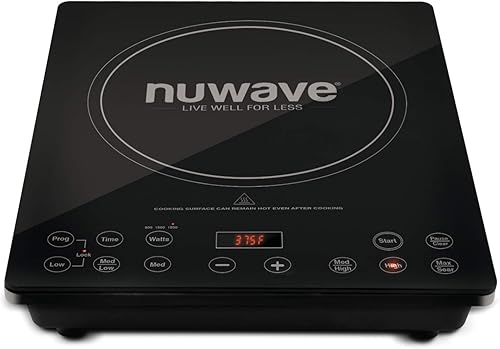
NuWave Pro Chef Induction Cooktop 1800W
As an Amazon Associate we earn from qualifying purchases. Product prices and availability are accurate as of the date/time indicated.
Frequently Asked Questions
Can I use cast iron on an induction cooktop?
Yes. Cast iron and enameled cast iron are magnetic and heat well. Lift the pan instead of sliding it, because rough bottoms can scratch the glass, and let heavy pans heat up gradually.
Why does my induction cooktop hum or buzz?
A low hum or buzz is normal at higher power levels, usually from the pan’s base vibrating in the magnetic field. Lighter or layered pans tend to be louder, and it often quiets when you lower the heat.
Can I keep a gas oven and add an induction cooktop?
Yes, if you install a separate cooktop and oven rather than a slide-in range. The cooktop still needs its own dedicated 240-volt circuit, and the oven keeps its gas connection, so both must be installed to code.
Does a magnetic stainless pan always work?
Not always. A magnet should stick firmly to the flat bottom, and the base must sit flat and be wide enough for the burner to detect it. Check your manual for the minimum pan size on your model.
{“@context”: “https://schema.org”, “@type”: “FAQPage”, “mainEntity”: [{“@type”: “Question”, “name”: “Can I use cast iron on an induction cooktop?”, “acceptedAnswer”: {“@type”: “Answer”, “text”: “Yes. Cast iron and enameled cast iron are magnetic and heat well. Lift the pan instead of sliding it, because rough bottoms can scratch the glass, and let heavy pans heat up gradually.”}}, {“@type”: “Question”, “name”: “Why does my induction cooktop hum or buzz?”, “acceptedAnswer”: {“@type”: “Answer”, “text”: “A low hum or buzz is normal at higher power levels, usually from the pan’s base vibrating in the magnetic field. Lighter or layered pans tend to be louder, and it often quiets when you lower the heat.”}}, {“@type”: “Question”, “name”: “Can I keep a gas oven and add an induction cooktop?”, “acceptedAnswer”: {“@type”: “Answer”, “text”: “Yes, if you install a separate cooktop and oven rather than a slide-in range. The cooktop still needs its own dedicated 240-volt circuit, and the oven keeps its gas connection, so both must be installed to code.”}}, {“@type”: “Question”, “name”: “Does a magnetic stainless pan always work?”, “acceptedAnswer”: {“@type”: “Answer”, “text”: “Not always. A magnet should stick firmly to the flat bottom, and the base must sit flat and be wide enough for the burner to detect it. Check your manual for the minimum pan size on your model.”}}]}