
For rice cooker vs slow cooker, pick a rice cooker for grains in about 20-45 minutes and a slow cooker for stews and roasts over 4-10 hours.
Rice cooker vs slow cooker at a glance
A rice cooker cooks a measured amount of grain and water until the water is gone, then stops. A slow cooker holds food at a low, steady temperature for hours. That difference in purpose drives everything else, and it is why the two only partly substitute for each other.
| Feature | Rice cooker | Slow cooker |
|---|---|---|
| Main job | Rice and other grains | Stews, roasts, chili, beans, soups |
| Typical cook time | About 20-45 minutes | About 4-10 hours (recipes on LOW typically take about twice as long as on HIGH) |
| Heat control | Thermostat detects when the water has boiled off | Low, steady heat through a ceramic or metal crock |
| Typical working temperature | About 212°F (boiling) while water remains | A low simmer; the exact temperature varies by model and setting |
| Keep warm | Switches to warm automatically when done | Varies by model: some switch to warm after the timer, some stay on until you turn them off |
| Capacity rating | Cups of uncooked rice | Quarts |
| Best for | Hands-off, consistent rice and small grain sides | Tough cuts, batch cooking and dinner ready after work |
| Main drawback | Cannot braise tough meat or run all day | Poor at rice and anything that needs quick cooking |
Times and temperatures are typical ranges, so check your manual for the exact figures for your model.
How each appliance controls heat
Rice cooker
A basic rice cooker heats at full power while water is liquid. Once the water is absorbed or boiled off, the pot temperature climbs past boiling, a thermostat senses it and the cooker flips to warm. That is why it is hard to burn rice and why it needs no timer. Micom (microcomputer) models add sensors and programs for brown rice, porridge and sushi rice. For water-to-rice amounts, use the rice cooker water ratio chart.
Slow cooker
A slow cooker heats the crock from the sides or base. LOW and HIGH usually end up at a similar simmering temperature, but HIGH gets there sooner, which is why a recipe that takes 8 hours on LOW often takes about 4 on HIGH. The lid stays on, so little liquid evaporates. Many models have no automatic shutoff, so the cook time is something you set and watch rather than something the appliance detects.
Can a rice cooker work as a slow cooker, or the reverse?
Rice in a slow cooker
It can be done, but results are uneven. Hours of low heat tend to give mushy rice and a scorched ring at the edge. Slow cooker rice works best in rice pudding or stirred into soup near the end of cooking, following a recipe written for that appliance. Because the lid traps moisture, stovetop or rice cooker water ratios usually need adjusting.
Soup or stew in a rice cooker
A basic one-switch rice cooker is a poor stand-in. It shuts off when the temperature rises past boiling, and its warm mode is meant to hold cooked food, not cook raw meat. Models with a porridge, soup or slow cook setting can handle congee, soups and small batches of stew, but the pot is small and the timing is set by the program. Check the manual for what each setting does.
Decision rule: if the recipe needs more than about 45 minutes or uses raw meat, use a slow cooker; if it is a grain or a small steamed side, use a rice cooker.
Which meals suit each appliance
Best in a rice cooker
- White and brown rice, using the brown setting on models that have one.
- Other grains your manual lists, since cooking charts differ by model.
- Congee or porridge on models with a porridge setting.
- Small steamed sides, if your model includes a steamer tray.
Best in a slow cooker
- Chili, stews and bean soups that improve with long, gentle cooking.
- Tough cuts such as chuck roast and pork shoulder, which soften over hours.
- Broth and stock that can simmer while you are away from the kitchen.
The schedule matters as much as the menu. A rice cooker fits a dinner you start less than an hour before eating. A slow cooker asks for prep earlier in the day, but once the lid is on it needs little attention until you are ready to eat.
Which should you choose for your household?
- Choose a rice cooker if you eat rice or other grains several times a week and want consistent results without watching a pot.
- Choose a slow cooker if you want dinner ready after a workday, cook tough cuts like chuck roast or pork shoulder, or batch-cook chili, soup and beans.
- Skip both if you have little counter space and already own a multi-cooker with rice and slow cook functions.
Worked example, family of 4: One cup of uncooked rice makes about 3 cups cooked, a rule of thumb that varies a little by rice type. If each person eats 1 cup cooked, you need 4 cups cooked, or 1⅓ cups uncooked (4 ÷ 3). A 3-cup rice cooker covers that, and a 5-cup model leaves room for leftovers or brown rice. For the slow cooker, many manuals call for filling the crock about half to two-thirds full. A 6-quart crock filled that way holds 3 to 4 quarts of food, which is 12 to 16 cups. That is enough for four people at 2 cups each (8 cups) with leftovers.
Each option loses somewhere. A rice cooker sits idle if you rarely eat grains. A slow cooker is too slow for a weeknight if you forget to start it in the morning. Once you pick a slow cooker, the slow cooker steps, times and safety guide covers fill levels and timing.
Is an Instant Pot a replacement for both?
For most households that want one appliance, yes. Many multi-cookers, including some Instant Pot models, combine pressure cooking, slow cooking, rice cooking and steaming in one pot, so check the function list on the model you are considering.
The trade-offs are real. A multi-cooker’s slow cook mode may not behave like a dedicated slow cooker, so recipes can need timing changes. Its rice program is usually less refined than a micom rice cooker. And one pot cannot cook rice and a stew at the same time. For a full comparison, read rice cooker vs Instant Pot.
Food safety rules for rice cookers and slow cookers
Both appliances have food safety limits. Follow your manual or label first, and keep these points in mind.
- Thaw meat before slow cooking. Frozen meat can sit in the 40-140°F danger zone too long while the crock heats up. Thaw it in the refrigerator first.
- Check internal temperature. USDA guidance calls for 165°F for poultry. Use a food thermometer.
- Keep the lid on and do not overfill. Use the fill limits in your manual.
- Do not hold rice on warm for many hours. Cooked rice can grow Bacillus cereus, a bacterium that causes food poisoning. Refrigerate leftovers soon after the meal.
Electricity use compared
The wattage on each label is the only reliable number for your model. Multiply watts by hours of heating and divide by 1,000 to get kilowatt-hours.
Example: a 200 W slow cooker running 8 hours uses 200 W x 8 h = 1,600 Wh, or 1.6 kWh. A 500 W rice cooker heating for half an hour uses 500 W x 0.5 h = 250 Wh, or 0.25 kWh. In this example the rice cooker uses less per meal because it runs briefly. Multiply the kWh by your utility’s rate per kWh to see the cost.
Our Top Picks
Ready to shop? These are the top-rated options from our hands-on roundup, Best Large Slow Cookers of 2026.
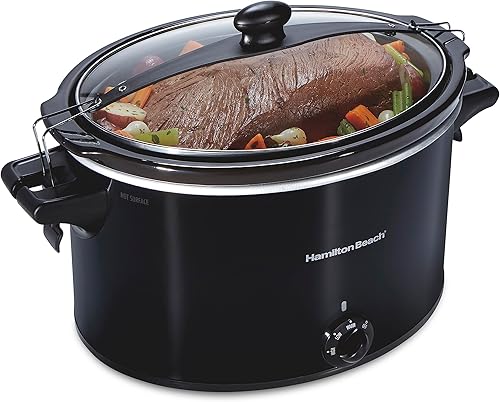
Hamilton Beach 10 Quart Portable Slow Cooker
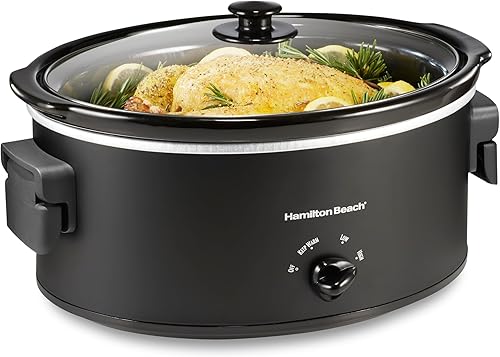
Hamilton Beach 6 Quart Slow Cooker with Folding Handles

Crock-Pot Cook N Carry 6-Quart Oval Slow Cooker
As an Amazon Associate we earn from qualifying purchases. Product prices and availability are accurate as of the date/time indicated.
Frequently Asked Questions
Can I steam vegetables in a rice cooker?
Yes, if your model includes a steamer tray or the manual says it can steam. Use the water amount and timing the manual lists, and add vegetables that cook quickly. Decision rule: no tray or steam instructions, use a stovetop steamer.
Is a 6-quart slow cooker too big for two people?
Not necessarily. If your manual calls for filling the crock at least half full, a 6-quart model needs about 3 quarts of food, which makes a large batch for two and suits freezing leftovers. If you mostly cook small portions, a smaller crock fits better.
Can I cook dry kidney beans in a slow cooker?
Not from raw. Red kidney beans contain a natural toxin, and the FDA advises soaking them and boiling for at least 10 minutes first, because low slow cooker temperatures may not destroy it. After that, finish them in the slow cooker following your recipe.
Is a rice cooker worth it if I already have a slow cooker?
Yes if you eat rice or other grains weekly, because a slow cooker is a poor rice maker and the rice cooker finishes in about 20-45 minutes. If you rarely eat grains, cooking them on the stovetop is enough.
{“@context”: “https://schema.org”, “@type”: “FAQPage”, “mainEntity”: [{“@type”: “Question”, “name”: “Can I steam vegetables in a rice cooker?”, “acceptedAnswer”: {“@type”: “Answer”, “text”: “Yes, if your model includes a steamer tray or the manual says it can steam. Use the water amount and timing the manual lists, and add vegetables that cook quickly. Decision rule: no tray or steam instructions, use a stovetop steamer.”}}, {“@type”: “Question”, “name”: “Is a 6-quart slow cooker too big for two people?”, “acceptedAnswer”: {“@type”: “Answer”, “text”: “Not necessarily. If your manual calls for filling the crock at least half full, a 6-quart model needs about 3 quarts of food, which makes a large batch for two and suits freezing leftovers. If you mostly cook small portions, a smaller crock fits better.”}}, {“@type”: “Question”, “name”: “Can I cook dry kidney beans in a slow cooker?”, “acceptedAnswer”: {“@type”: “Answer”, “text”: “Not from raw. Red kidney beans contain a natural toxin, and the FDA advises soaking them and boiling for at least 10 minutes first, because low slow cooker temperatures may not destroy it. After that, finish them in the slow cooker following your recipe.”}}, {“@type”: “Question”, “name”: “Is a rice cooker worth it if I already have a slow cooker?”, “acceptedAnswer”: {“@type”: “Answer”, “text”: “Yes if you eat rice or other grains weekly, because a slow cooker is a poor rice maker and the rice cooker finishes in about 20-45 minutes. If you rarely eat grains, cooking them on the stovetop is enough.”}}]}