A rice cooker boils over mostly because of starch foam from unrinsed rice, too much water, or filling the pot past its max line. Rinse the rice, measure with the pot’s own cup lines, and keep the lid and vent clean, and the spitting usually stops.
Read the timing to find the cause
When the foam appears tells you where to look first. Work down this table from the top and stop at the first row that matches.
| What you see | Most likely cause |
|---|---|
| Foam and starchy water spit out in the first few minutes of boiling | Surface starch on unrinsed rice |
| Water bubbles up the sides and reaches the rim | Too much water or too much rice in the pot |
| Water drips from the lid edge, not the vent | Inner lid or seal not seated |
| Spitting from the vent that gets worse over weeks | Starch residue clogging the vent |
| Overflow late in the cycle, with a wobbling or tilted base | Uneven surface or weight on the lid |
A few drops of foam at the vent once per cycle is normal. Water that runs down the outside and pools under the cooker is not.
Rinse the rice to cut starch foam
Loose starch on the grains is the top cause. It turns the boiling water into a thick foam that climbs the pot and pushes out the vent. It can also scorch on the bottom.
- Put the measured rice in a fine-mesh sieve or the inner pot.
- Run cold water over it and swirl with your fingers until the water turns cloudy.
- Drain and repeat. Two to three rinses is enough once the water looks mostly clear.
- Shake the sieve and let the rice drain for a minute so you are not adding extra water.
Brown rice needs the same rinse and drain. If the foam is still heavy, stir about 1 teaspoon of butter or oil into the rice and water. It breaks the surface tension so bubbles pop sooner. Check your manual first if you have a delicate nonstick pot.
Measure rice and water by the pot’s cup lines
Most rice cookers ship with a plastic cup that holds about 180 ml, roughly 3/4 of a US cup (240 ml). The numbered lines inside the pot are made for that small cup. Scooping with a US measuring cup puts a third more rice in the pot than the lines expect (240 ÷ 180 = 1.33).
Worked example: a 5.5-cup cooker holds 5.5 x 180 ml = 990 ml of rice at its max line, a little over 4 US cups. If you scoop 5 US cups, that is 5 x 240 ml = 1,200 ml, or about 6.7 rice-cooker cups. That is over the max line, so the foam has nowhere to go.
Fill water to the line that matches your rice type and amount, using the markings for white, sushi or brown. For white rice, water is often about 1:1 with the rice by the cooker’s cup line, but ratios differ by model and rice, so confirm in your manual. Our rice cooker water ratio chart shows how to adjust when your pot has no lines.
Check the lid, vent and condensation collector
Starch builds up in the steam vent and on the inner lid. A clogged vent forces steam and foam out through the gaps instead. Unplug the cooker and let it cool before you clean anything.
- Remove the inner lid or steam cap if your model allows it, and wash it in warm soapy water.
- Clear the vent hole with a soft brush or cotton swab. Never use a metal pin that could scratch parts.
- Empty and rinse the condensation collector, the small cup on the back or side.
- Reseat the inner lid until it clicks, then close the outer lid fully.
- Look at the rubber gasket for cracks, stretching or stiffness. A worn gasket lets foam leak.
Never hold the vent shut or prop the lid open to stop foam. Pressure and induction models need a clear vent and a good seal to work safely. Our step-by-step rice cooker guide covers the normal setup.
Set the cooker on a level surface with nothing on the lid
Place the cooker on a hard, flat counter away from the edge, with all feet level and room for steam above it. Not under a low cabinet. Don’t rest anything on the lid. Make sure the pot’s underside and the heating plate are dry and free of grains so the pot sits flush. A tilted or rocking cooker can push water toward one side and over the rim.
When a rice cooker that boils over is faulty
Fix the rinse, water and fill level first. If it still floods after one clean cycle with correct amounts, suspect the cooker itself.
- The inner pot is dented or warped and rocks on the heating plate.
- The lid will not seat flat, or the gasket is cracked or loose.
- The cooker keeps boiling hard long after the rice should be done.
- Water or starch runs into the base, or you smell burning or see scorch marks near the vents.
If you see any of these, unplug it and stop using it. Rice that takes far longer than the usual time points to a sensor or thermostat problem, so compare against our rice cooker cook time chart.
After any overflow, unplug and cool the cooker, then wipe the heating plate and thermal sensor with a damp cloth. Dry them fully before the next use. Never let water into the base or electrical parts.
Our Top Picks
Ready to shop? These are the top-rated options from our related roundup, Best Rice Cooker Under $100 of 2026.
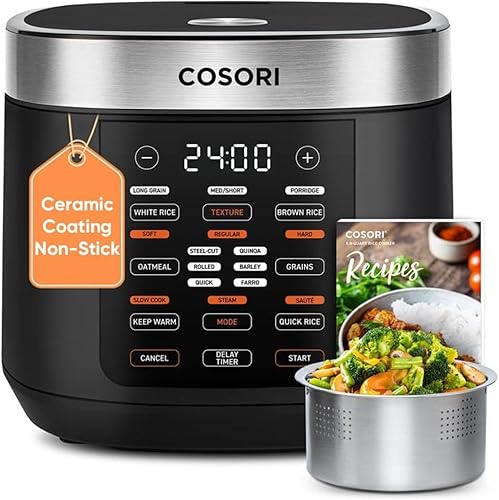
Cosori 10-Cup Rice Cooker with Fuzzy Logic

Zojirushi 6-Cup Rice Cooker NHS-10

Toshiba TRCS02 Mini Rice Cooker, 3-Cup Fuzzy Logic
As an Amazon Associate we earn from qualifying purchases. Product prices and availability are accurate as of the date/time indicated.
Frequently Asked Questions
Is rice that boiled over still safe to eat?
Yes, if it finished cooking and was held at normal temperature. It may be gummy or have a scorched layer on the bottom from extra starch. Skip any rice that smells burnt or sat out for hours.
Can I cook a very small batch in a large cooker?
Only down to the minimum amount in your manual. Below it, the thin layer of rice and water can spit and cook unevenly. Use the smallest line marked on the pot, or a smaller cooker.
Why does it boil over only with brown rice?
Brown rice usually takes more water and a longer cook, so the pot is fuller and foams for longer. Rinse it, use the brown line, and don’t exceed the max line.
Is a multi-cooker or Instant Pot different?
Pressure and multi-cooker models have their own fill limits and venting rules. Follow the manual’s rice setting and max line rather than the rice cooker cup lines.
{“@context”: “https://schema.org”, “@type”: “FAQPage”, “mainEntity”: [{“@type”: “Question”, “name”: “Is rice that boiled over still safe to eat?”, “acceptedAnswer”: {“@type”: “Answer”, “text”: “Yes, if it finished cooking and was held at normal temperature. It may be gummy or have a scorched layer on the bottom from extra starch. Skip any rice that smells burnt or sat out for hours.”}}, {“@type”: “Question”, “name”: “Can I cook a very small batch in a large cooker?”, “acceptedAnswer”: {“@type”: “Answer”, “text”: “Only down to the minimum amount in your manual. Below it, the thin layer of rice and water can spit and cook unevenly. Use the smallest line marked on the pot, or a smaller cooker.”}}, {“@type”: “Question”, “name”: “Why does it boil over only with brown rice?”, “acceptedAnswer”: {“@type”: “Answer”, “text”: “Brown rice usually takes more water and a longer cook, so the pot is fuller and foams for longer. Rinse it, use the brown line, and don’t exceed the max line.”}}, {“@type”: “Question”, “name”: “Is a multi-cooker or Instant Pot different?”, “acceptedAnswer”: {“@type”: “Answer”, “text”: “Pressure and multi-cooker models have their own fill limits and venting rules. Follow the manual’s rice setting and max line rather than the rice cooker cup lines.”}}]}