For a rice cooker vs air fryer choice, buy a rice cooker if you cook rice 3+ times a week and an air fryer if you mostly want crispy food, because neither fully replaces the other.
Rice cooker vs air fryer: which should you buy if you can only have one?
Buy for the food you cook most often. Rule of thumb: rice or grains 3+ times a week, get a rice cooker; otherwise, get an air fryer. Count what you made last week: meals built on rice, grains or porridge point to a rice cooker, and meals built on wings, fries, roasted vegetables or reheated leftovers point to an air fryer.
Choose a rice cooker if…
- You eat rice, sushi rice, brown rice or other grains 3+ times a week.
- You want to press a button and walk away, with no timing or shaking.
- You cook for a family and want rice kept warm until dinner.
- You like steamed vegetables, dumplings, porridge or one-pot rice dishes.
Choose an air fryer if…
- You want crisp skin, golden fries or roasted vegetables without heating a full oven.
- You reheat pizza, fried chicken or fries often and hate soggy leftovers.
- Your rice is occasional and a pot on the stove is fine.
Where each loses: a rice cooker cannot crisp or roast anything. An air fryer cannot reliably cook raw rice, especially sticky short-grain rice.
If budget is the limit, start with the job you will use most. Our guide to the best rice cookers under $100 shows what a basic model can do.
What does each appliance do best?
A rice cooker heats a sealed inner pot with water until the water is absorbed, then usually switches to keep-warm. An air fryer circulates hot, dry air around food in a basket. That is why one excels at moist, even cooking and the other at browning and crisping.
| Task | Rice cooker | Air fryer |
|---|---|---|
| White, jasmine or sushi rice | Best choice, hands-off | Poor; sticky rice cooks unevenly |
| Brown rice and other grains | Good; many models have a brown or mixed setting | Unreliable |
| Crispy wings, fries, roasted vegetables | Cannot do it | Best choice |
| Reheating fries, pizza, fried chicken | Keep-warm only; food goes soft | Best choice |
| Reheating plain rice | Good with a splash of water | Dries it out unless covered |
| Steaming vegetables, fish, dumplings | Good if a steam tray is included | Not suited |
| Porridge, soup, one-pot rice dishes | Good on many models | Limited by the basket |
| Crispy fried rice | Cooks the rice first | Crisps chilled, day-old rice well |
Features vary by model, so check the manual for steam trays and porridge or brown rice settings before counting on them.
Can an air fryer cook rice, and can a rice cooker do more than rice?
An air fryer can cook rice, but it is an unreliable workaround. Raw rice needs simmering water and a tight seal. The usual approach puts rinsed long-grain rice and water in a covered, oven-safe pan inside the basket, but dry air may not bring a sealed pan to a steady simmer. Results vary by model and recipe, so we do not give a set time or temperature. If you try it, follow your air fryer manual and expect trial and error.
Short-grain and sticky rice tend to turn out gummy or uneven, and brown rice is even harder to get right.
The air fryer is better at what happens after the rice is cooked. Chilled rice is drier and crisps better than fresh rice, which is sticky. For crispy fried rice, spread cold rice with a little oil and your vegetables in the basket. As a rule of thumb, many recipes use roughly 350°F for 8 to 10 minutes, shaking halfway; times vary by model.
A rice cooker can do more than rice. It works well for steaming vegetables or fish, cooking oats and other grains, making porridge, and simmering simple soups or one-pot rice meals. Some models can form a crisp rice crust on the bottom, but it will not match air fryer crispness. Water amounts still matter, so use our rice cooker water ratio chart for the grain you are cooking.
Rice cooker vs air fryer: capacity, wattage, footprint and cleanup
These are typical ranges, not fixed specs. Check the label and manual for your exact model.
| Factor | Rice cooker | Air fryer |
|---|---|---|
| Typical power | About 300 to 700 W | About 1,400 to 1,800 W |
| Typical capacity | 3 to 10 cups of uncooked rice (a rice cooker cup is about 3/4 US cup) | About 2 to 8 qt basket; dual-basket models are larger |
| How it ends | Switches to keep-warm automatically | Stops at the timer; food needs checking |
| Hands-on time | Add rice and water, press start | Preheat on some models, shake or flip food |
| Cleanup | Removable inner pot, lid and steam vent | Basket and tray; grease builds up |
Cost example (estimate): multiply kilowatts by hours by your rate. Assume $0.17 per kWh, a 600 W rice cooker running 30 minutes (0.6 kW x 0.5 h = 0.3 kWh, about 5 cents) and a 1,500 W air fryer running 20 minutes (1.5 kW x 0.33 h = 0.5 kWh, about 9 cents). At 4 meals a week, that is roughly 20 cents versus 34 cents. This assumes full wattage the whole time, so real cost is usually lower. Your rate and models will differ.
Circuit note: at 1,400 to 1,800 W, an air fryer draws about 12 to 15 amps at 120 volts (watts divided by volts), so avoid sharing a circuit with another high-wattage appliance.
Cleanup: nonstick inner pots and baskets scratch easily, so use soft sponges and wooden or silicone tools. Many baskets are dishwasher-safe, but confirm in your manual. If crispy cooking is your priority, see our picks for the best air fryers.
Is a multi cooker a better compromise?
A multi cooker with an air fryer lid can cook rice and also crisp food, so it can save space if you want both jobs in one footprint. It is a real compromise, not a perfect replacement.
- You gain: one appliance for rice, soups, pressure cooking and air frying.
- You lose: counter space, since these units are larger than either appliance alone, and a lid to store.
- You lose: rice fine-tuning. Dedicated rice cookers are built around rice, and a multi cooker’s rice results vary by model.
- You lose: air-frying capacity. The basket or tray is often smaller than a standalone air fryer’s.
Choose a combo if you have room for one larger appliance and cook rice casually. Stay with a dedicated rice cooker if rice is a daily staple or you cook sushi or short-grain rice. For options, see our air fryer and rice cooker combo guide.
Safety and common mistakes with both appliances
- Air fryer clearance and foil: hot exhaust air needs room, so follow the manual for clearance from walls and cabinets. Also follow the manual on whether foil is allowed; loose foil can blow into the heating element, so never leave it unsecured.
- Air fryer rice: use a covered, oven-safe container the manual permits. Hot water can spill when you remove it.
- Overfilling a rice cooker: starchy foam can spill and block the steam vent. Stay at or under the max line in the pot.
- Keep-warm and leftover rice: rice dries out and yellows over hours on keep-warm, and cooked rice can grow Bacillus cereus if left at room temperature. USDA advises refrigerating cooked food within 2 hours, so cool the rice quickly, refrigerate it, and use it within a day or two.
Common mistake: buying an air fryer mainly to cook rice. If rice is your main goal, a rice cooker will be more reliable and easier to use.
Our Top Picks
Ready to shop? These are the top-rated options from our hands-on roundup, Best Air Fryer Rice Cooker Combo of 2026.
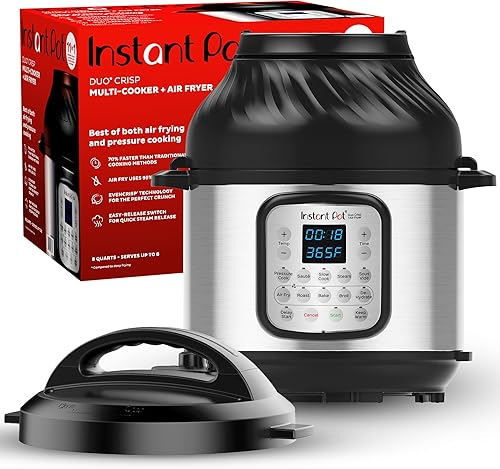
Instant Pot Duo Crisp 8 Qt 11-in-1 Air Fryer + PC

Aroma ARC-5204SB 8-Cup Digital Rice Cooker

COSORI Mini Air Fryer & Rice Cooker Combo, 2.1 Qt
As an Amazon Associate we earn from qualifying purchases. Product prices and availability are accurate as of the date/time indicated.
Frequently Asked Questions
Is a rice cooker worth it if I already have an air fryer?
Yes, if you cook rice or grains regularly. An air fryer cannot reliably cook raw rice, especially short-grain or sticky types, while a rice cooker gives even results with no watching. If you eat rice only occasionally, a stovetop pot is enough.
Can I cook rice in an air fryer oven?
It is possible but unreliable. A toaster-style air fryer oven has the same dry-air problem, so rice needs a covered, oven-safe pan and plenty of trial and error. Follow your manual on cookware and foil. A rice cooker is the better tool for consistent rice.
Can a rice cooker reheat leftovers?
Yes, for rice, soups and steamed dishes. Add a splash of water to leftover rice, close the lid and run a cook cycle, then check that it is steaming hot. USDA advises reheating leftovers to 165°F. It will not re-crisp fried foods or pizza.
Is an air fryer healthier than a rice cooker?
Not really; they are different tools. An air fryer can use less oil than deep frying, and a rice cooker adds no fat. How healthy a meal is depends mostly on the food and the ingredients you add, not the appliance.
Can I steam vegetables in a rice cooker?
Yes, if your model includes a steam tray or basket. Add water to the pot, place the vegetables in the tray, and cook until tender. Check the manual for water amounts. Models without a steam tray may not suit this.
{“@context”: “https://schema.org”, “@type”: “FAQPage”, “mainEntity”: [{“@type”: “Question”, “name”: “Is a rice cooker worth it if I already have an air fryer?”, “acceptedAnswer”: {“@type”: “Answer”, “text”: “Yes, if you cook rice or grains regularly. An air fryer cannot reliably cook raw rice, especially short-grain or sticky types, while a rice cooker gives even results with no watching. If you eat rice only occasionally, a stovetop pot is enough.”}}, {“@type”: “Question”, “name”: “Can I cook rice in an air fryer oven?”, “acceptedAnswer”: {“@type”: “Answer”, “text”: “It is possible but unreliable. A toaster-style air fryer oven has the same dry-air problem, so rice needs a covered, oven-safe pan and plenty of trial and error. Follow your manual on cookware and foil. A rice cooker is the better tool for consistent rice.”}}, {“@type”: “Question”, “name”: “Can a rice cooker reheat leftovers?”, “acceptedAnswer”: {“@type”: “Answer”, “text”: “Yes, for rice, soups and steamed dishes. Add a splash of water to leftover rice, close the lid and run a cook cycle, then check that it is steaming hot. USDA advises reheating leftovers to 165°F. It will not re-crisp fried foods or pizza.”}}, {“@type”: “Question”, “name”: “Is an air fryer healthier than a rice cooker?”, “acceptedAnswer”: {“@type”: “Answer”, “text”: “Not really; they are different tools. An air fryer can use less oil than deep frying, and a rice cooker adds no fat. How healthy a meal is depends mostly on the food and the ingredients you add, not the appliance.”}}, {“@type”: “Question”, “name”: “Can I steam vegetables in a rice cooker?”, “acceptedAnswer”: {“@type”: “Answer”, “text”: “Yes, if your model includes a steam tray or basket. Add water to the pot, place the vegetables in the tray, and cook until tender. Check the manual for water amounts. Models without a steam tray may not suit this.”}}]}