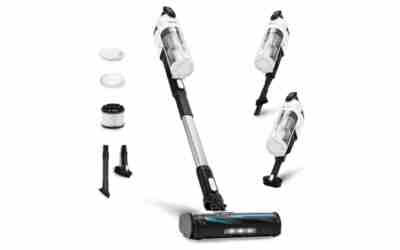
Stick vacuums are good enough to be a main vacuum in small to mid-size homes, but large carpeted houses are better served by a corded upright. The deciding factors are battery runtime on the power mode you actually use, bin size, and how much carpet you have.
Are stick vacuums any good at cleaning? It depends on the model
Category averages hide big gaps. In CHOICE’s Australian lab tests, stick vacuums averaged about 76% on hard floors, yet some models scored as low as 10%. Consumer NZ’s latest tests found almost no difference between stick and standard vacuums on carpet and pet hair. A good stick cleans like a full-size machine, but a weak one is a real risk.
Beyond raw cleaning, sticks win on everyday convenience:
- Weight and handling: they are easy to steer around furniture and carry up stairs, and most convert to a handheld for stairs, car seats and shelves.
- Storage: they stand in a closet or hang on a wall dock, so people tend to use them more often.
- No cord: you skip the outlet hunt, which matters most in homes with many small rooms.
The trade-off is that all of this runs on a battery, which is where most disappointments start.
How long a stick vacuum battery really lasts
Typical claimed runtime is about 20 to 60 minutes per charge on low or medium power. Those figures are usually measured on the lowest suction with no motorized floor head running, so real runtime on max power or with a carpet head is much shorter. CHOICE reviewed one budget stick that ran only 10 minutes on max.
Look for runtime listed per power mode, not a single headline number. Charge time is also model-specific, so check the manual. A long recharge matters if your home needs more than one battery’s worth of cleaning.
Worked example: will one charge cover your home?
Use these typical values: a 1,500 sq ft home, a cleaning pace of 50 sq ft per minute, a battery that lasts 12 minutes on max power, and 40 minutes on standard power. Swap in the numbers from your model’s spec sheet.
- 600 sq ft of carpet on max: 600 ÷ 50 = 12 minutes, or 100% of the battery.
- 900 sq ft of hard floor on standard: 900 ÷ 50 = 18 minutes, or 45% of the battery.
Add the shares: 100% + 45% = 145%. That means one recharge mid-clean. If your total stays under 100%, one charge covers the house.
Stick vacuums vs uprights on carpet and pet hair
On carpet and pet hair, a well-built stick can match an upright for performance. The difference is how long it can keep that performance up.
| Factor | Cordless stick | Corded upright |
|---|---|---|
| Carpet and pet hair | Near-equal in Consumer NZ tests | Near-equal in Consumer NZ tests |
| Hard floors | 76% average in CHOICE tests, lowest score 10% | Not measured in that test |
| Power supply | Battery, runtime drops on max | Wall outlet, no runtime limit |
| Dust bin | Smaller than an upright’s | Typically 1 to 2 liters |
| Price for equal cleaning | Higher | Lower |
Cordless uprights exist, but they generally cost much more than a corded upright that cleans as well or better. For shag or very deep pile, a brush roll can tangle or pull fibers, so read how to vacuum shag area rugs without damaging them before you run any stick over one.
Main drawbacks: bin size, battery wear and replacement cost
Bin size. A small bin fills quickly in a house with shedding pets, so expect to empty it mid-clean. Empty it after each session so suction does not drop.
Battery wear. Lithium-ion batteries lose capacity with every charge cycle. The runtime you buy in year one is not the runtime you have in year three, and a fully worn battery can turn a good vacuum into a short-lived one.
Replacement cost. Whether you can swap the battery yourself depends on the model. Some use a removable pack, while others need a repair service. Check the replacement battery’s price and availability before you buy, because that cost can approach a large share of a cheaper vacuum’s price.
Battery safety matters as well:
- Charge with the manufacturer’s charger on a hard, non-flammable surface, away from heat.
- Stop using the vacuum if the battery swells, overheats or smells.
- Never vacuum hot embers, ash or liquids.
- Recycle a dead battery at a proper drop-off point, not in household trash.
Specs to check before you rely on a stick vacuum
- Runtime per mode with the motorized head on. If only the lowest-power number is listed, assume max power runs far shorter.
- Removable battery. A swappable pack extends both daily coverage and the vacuum’s lifespan. Confirm the warranty terms for the battery separately.
- Bin capacity. Compare it with the 1 to 2 liters typical of an upright, especially if you have pets.
- Sealed filtration. If anyone has allergies, look for a sealed system with a HEPA-grade filter. CHOICE notes a traditional barrel or upright may suit allergy sufferers better.
- Motorized brush head for carpet. A non-motorized floor head is weak on rugs.
- Weight. Check it if stairs or reduced strength are a factor, since the motor and battery sit in the handle.
Cheap models are the riskiest, because the low-power runtime on the box can hide a very short max-power runtime. If you want a stick’s handling without a battery, a corded stick such as the Shark Rocket Pet Plus HV322 removes runtime and battery wear from the equation.
Who should buy a stick vacuum and who should keep an upright
A stick works as your main vacuum if
- You live in an apartment, condo or small to mid-size home.
- Most floors are hard surfaces or low-pile carpet.
- Your worked-example total stays under 100% of one battery, or you can buy a spare.
- You want something light for stairs and quick daily cleanups.
Keep a corded upright if
- You have a large home or wall-to-wall carpet throughout.
- Heavy shedding pets or big, deep cleans are the norm.
- Allergies are a concern and you want the stronger filtration path.
- You want the lowest upfront cost for equal cleaning power.
A common middle path is an upright for weekly deep cleans plus a stick for daily touch-ups. If pets are the main factor, the guide to the best vacuums for pet hair compares both types, and it is worth checking bin size and brush-roll tangling when you choose.
Our Top Picks
Ready to shop? These are the top-rated options from our related roundup, Best Stick Vacuums of 2026.

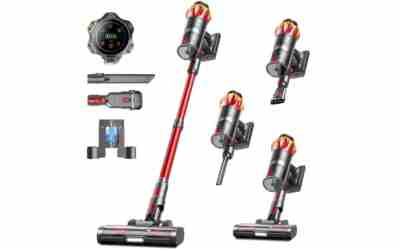
JELLYPIG Cordless Vacuum Cleaner 650W 55KPA 70Mins Self-Standing Touch Screen Anti-tangle for Home Pet Hair

Shark Pet Cordless Stick Vacuum IX141

Shark IZ363HT Cordless Vacuum, 50-Min Runtime
As an Amazon Associate we earn from qualifying purchases. Product prices and availability are accurate as of the date/time indicated.
Frequently Asked Questions
Can a stick vacuum handle stairs?
Yes. Stick vacuums are light, need no outlet and usually convert to a handheld, which makes stairs one of their best uses. Check the weight if you carry it one-handed, because the motor and battery sit near the handle.
Can I replace a stick vacuum battery myself?
It depends on the model. Some have a removable pack you swap in seconds, while others need a service repair. Check the manual and the replacement battery’s availability before you buy, not after the runtime fades.
Can I use a stick vacuum on spills or ashes?
No. Do not vacuum liquids, hot embers or ash with a stick vacuum. Liquids can damage the motor and electronics, and embers can ignite the dust bin or filter. Use a wet-dry shop vacuum or clean these up by hand.
Are cheap stick vacuums worth it?
Only as a light supplement. Budget models often advertise runtime measured on the lowest setting, and one reviewed by CHOICE ran just 10 minutes on max power. For a main vacuum, a corded upright costs less for the same cleaning.
{“@context”: “https://schema.org”, “@type”: “FAQPage”, “mainEntity”: [{“@type”: “Question”, “name”: “Can a stick vacuum handle stairs?”, “acceptedAnswer”: {“@type”: “Answer”, “text”: “Yes. Stick vacuums are light, need no outlet and usually convert to a handheld, which makes stairs one of their best uses. Check the weight if you carry it one-handed, because the motor and battery sit near the handle.”}}, {“@type”: “Question”, “name”: “Can I replace a stick vacuum battery myself?”, “acceptedAnswer”: {“@type”: “Answer”, “text”: “It depends on the model. Some have a removable pack you swap in seconds, while others need a service repair. Check the manual and the replacement battery’s availability before you buy, not after the runtime fades.”}}, {“@type”: “Question”, “name”: “Can I use a stick vacuum on spills or ashes?”, “acceptedAnswer”: {“@type”: “Answer”, “text”: “No. Do not vacuum liquids, hot embers or ash with a stick vacuum. Liquids can damage the motor and electronics, and embers can ignite the dust bin or filter. Use a wet-dry shop vacuum or clean these up by hand.”}}, {“@type”: “Question”, “name”: “Are cheap stick vacuums worth it?”, “acceptedAnswer”: {“@type”: “Answer”, “text”: “Only as a light supplement. Budget models often advertise runtime measured on the lowest setting, and one reviewed by CHOICE ran just 10 minutes on max power. For a main vacuum, a corded upright costs less for the same cleaning.”}}]}